

Why Artisanal Coffee Tastes Different
Table of Contents
- The Foundation: How Origin and Terroir Shape Flavor
- Why Fresh Roasted Coffee Beans Deliver Superior Taste
- Roast Profiles and Development: The Art of Transformation
- Water Chemistry and Extraction: Often Overlooked Variables
- How to Brew Artisanal Coffee at Home for Maximum Flavor
- The Psychology of Taste Perception in Coffee
- Troubleshooting Sensory Defects in Your Cup
- Conclusion
Last Updated: August 23, 2026
The Foundation: How Origin and Terroir Shape Flavor
The flavor in your cup begins long before the roast. Where coffee grows, the altitude, soil composition, climate, and local growing practices, creates a foundation that no roasting technique can fully override. This is terroir, and it's the first reason why artisanal coffee tastes different from commodity beans.
Coffee from the volcanic highlands of Bali tastes nothing like coffee from Colombia's tropical valleys. A bean grown at 1,200 meters develops different compounds than one grown at 1,900 meters (peer-reviewed research). The altitude affects how quickly the cherry ripens, which influences the density of the bean and the concentration of sugars and acids that eventually become flavor notes you can identify in the cup.
Regnal Roasts sources single-origin coffees specifically to preserve these terroir characteristics. Their Bali Blue, grown in the volcanic loam soils of Kintamani at 1,200-1,600 meters, develops the dark chocolate and molasses notes that define that origin. Their Ethiopia Natural, sourced from the higher Sidama zone at 1,700-1,900 meters, shows completely different sensory markers: milk chocolate, fruity notes, and caramel.

The processing method, whether the coffee cherry is washed, natural-processed, or wet-hulled, also shapes what you taste. A fully washed coffee like the Colombia variety emphasizes bright acidity and clarity of flavor. A natural-processed coffee like the Ethiopia variety tends toward deeper sweetness and more pronounced fruit characteristics. These aren't subtle differences. They're fundamental shifts in which compounds make it into your final brew.
Why Fresh Roasted Coffee Beans Deliver Superior Taste
Freshness is where most coffee drinkers go wrong. The moment a coffee bean is roasted, it begins to oxidize. Within two weeks, the aromatic compounds that define complexity start to fade (peer-reviewed research). By four weeks, you're tasting a flattened version of what the roaster intended.
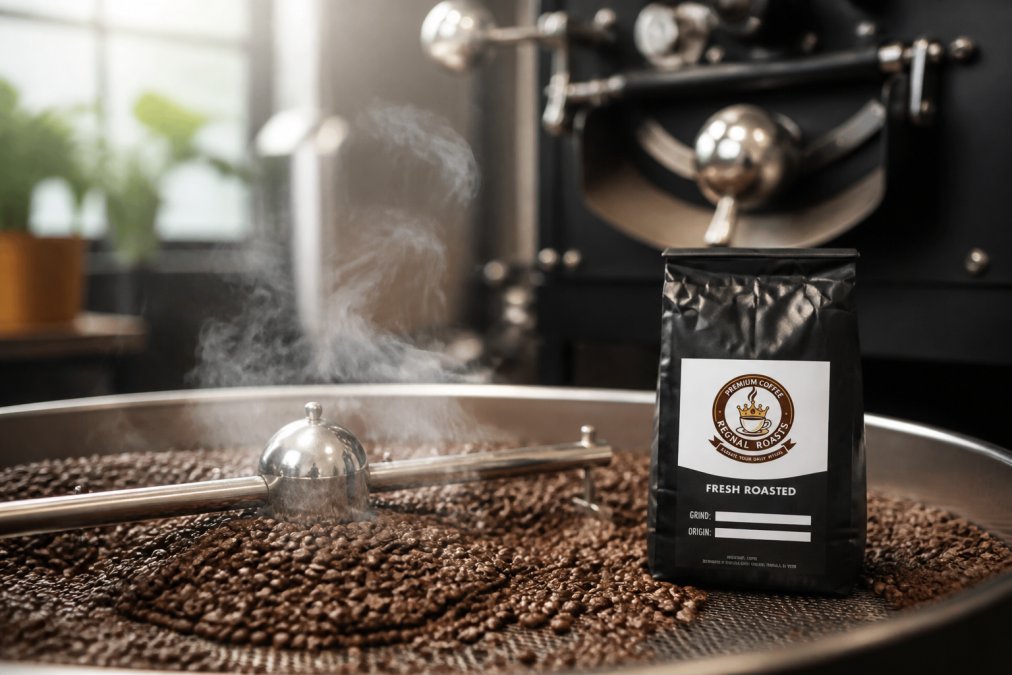
Fresh roasted coffee beans retain their full sensory profile because the volatile aromatics haven't had time to degrade. When you brew beans roasted within the last 7-10 days, you're experiencing the roaster's full vision. The acidity is brighter, the body feels more present, and the flavor notes are distinct rather than blurred together.
This is why artisanal roasters emphasize small-batch, frequent roasting schedules. Regnal Roasts offers fresh roasted unique blends. The difference in cup quality is immediate and obvious to anyone paying attention.
Stale coffee doesn't just taste flat. It tastes bitter in a way that has nothing to do with the roast profile or brewing technique. This bitterness is oxidation, not intended flavor. Many people interpret this staleness as "strong" coffee and adjust their brewing method accordingly, making the problem worse. Fresh beans eliminate this variable entirely.
Storage matters too. Once you receive your beans, keep them in an airtight container away from direct sunlight and heat. Whole beans stay fresher longer than pre-ground coffee because grinding dramatically increases surface area exposed to oxygen. If you grind your beans right before brewing, you maximize the freshness advantage.
Roast Profiles and Development: The Art of Transformation
The roast profile determines which flavor compounds are highlighted and which are suppressed. A light roast develops fewer compounds through heat, preserving the origin's natural acidity and brightness. A dark roast develops more compounds through extended heat exposure, creating deeper body, lower acidity, and flavors associated with the roasting process itself (chocolate, caramel, smoke).
Artisanal roasters use precise temperature control and timing to hit specific roast profiles. They're listening for the "first crack" and "second crack", audible signals that indicate the bean's internal structure is expanding and cracking. The moment a roaster stops the heat determines the final roast level and flavor outcome.
Consider the difference between the Regnal Roasts Colombia (medium roast) and Bali Blue (medium-dark roast). The Colombia is roasted to a point where the origin's brightness and berry notes come through clearly. The Bali Blue is roasted longer, allowing the volcanic terroir and the wet-hulled processing to express as deeper chocolate and molasses notes. Neither is "better", they're different expressions of their origins, created through intentional roast decisions.

The Agtron scale provides a standardized way to measure roast color, but the real measure is flavor development. A roaster's skill lies in understanding how each origin responds to heat and stopping at the precise point where the intended flavor profile emerges. This requires experience, attention, and usually multiple test batches to dial in.
Water Chemistry and Extraction: Often Overlooked Variables
Most people focus on the coffee and the roast, then ignore the water. This is a critical mistake. Water makes up 98% of your final cup, and its mineral content directly affects extraction, the process of dissolving soluble compounds from the grounds into the water.
Water with too few dissolved minerals (soft water) extracts too quickly and unevenly, pulling out sharp, sour notes. Water with too many minerals (hard water) extracts too slowly, leaving you with weak, under-extracted coffee. The ideal range is somewhere in the middle, with enough minerals to facilitate even extraction without over-mineralization.
Total dissolved solids (TDS) is the measurement that matters. Specialty coffee typically targets water in the 150-200 ppm (parts per million) range. If your tap water is significantly softer or harder, you're fighting an uphill battle no matter how good your beans are.
The practical fix: use filtered water. A basic carbon filter removes chlorine and some minerals. A reverse osmosis filter removes nearly everything, which then requires adding back some minerals through a re-mineralization cartridge. Both approaches cost less than a month's worth of premium coffee and make a noticeable difference in cup quality.
Extraction time matters equally. If you're brewing pour-over, the water contact time with the grounds should be around 3-4 minutes. If you're using a French press, 4 minutes is standard. If you're using a single-serve machine, the manufacturer's timing is usually optimized. The goal is to dissolve the right amount of soluble material, enough for complexity, not so much that you get bitterness and harshness.
How to Brew Artisanal Coffee at Home for Maximum Flavor
The brew method you choose determines how much control you have over extraction variables. Some methods are forgiving; others demand precision. All of them can produce excellent coffee if you understand the mechanics.
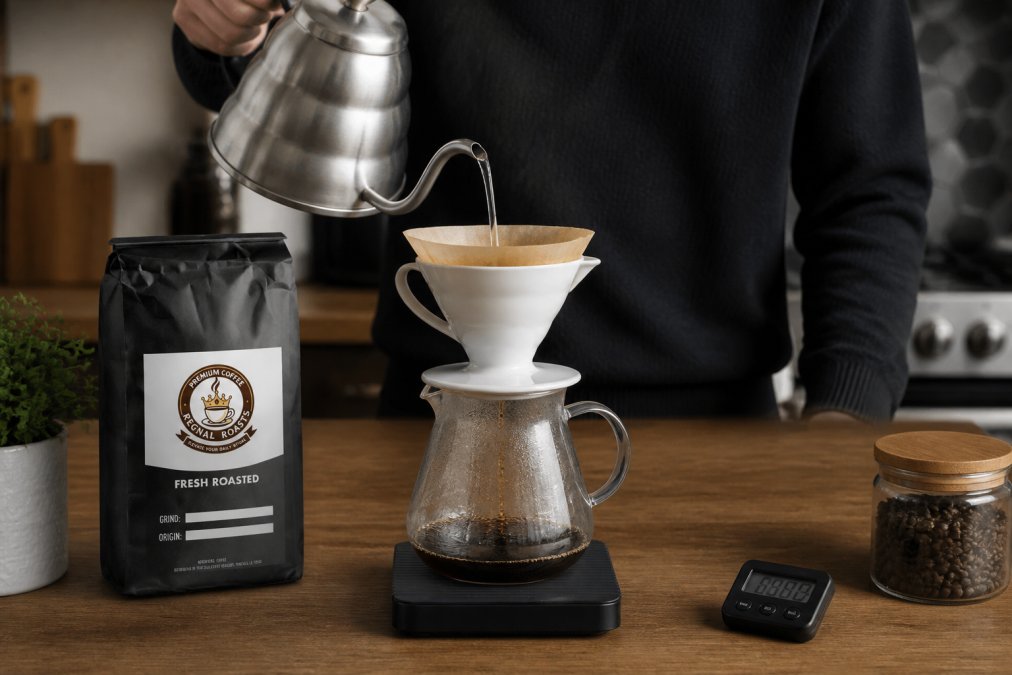
Pour-over brewing gives you the most control. You're manually managing water temperature, pour rate, and contact time. Start with a 1:16 coffee-to-water ratio (for example, 25 grams of coffee to 400 grams of water). Use water between 195-205°F. Pour slowly, allowing the grounds to "bloom" for 30-45 seconds before the main pour. The total brew time should reach 3-4 minutes.
French press is simpler but less precise. Use the same 1:16 ratio, water at 200°F, and steep for 4 minutes before pressing. The advantage is minimal equipment. The disadvantage is that fine particles stay in contact with water the entire time, which can over-extract if you're not careful.
Single-serve machines (including K-Cup compatible brewers) are convenient but offer less control over extraction. The quality depends entirely on the pod itself. This is where fresh roasted beans in quality pods make the biggest difference. Regnal Roasts offers K-Cup compatible pods with their handcrafted blends.
Grind size is non-negotiable. Coarse grinds for French press, medium grinds for pour-over, fine grinds for espresso. If your grind is wrong, extraction goes sideways regardless of everything else you do correctly. Invest in a burr grinder (not a blade grinder) and dial in the grind size for your specific brew method.
Water temperature matters more than most people realize. Too hot and you over-extract, pulling out harsh, bitter compounds. Too cool and you under-extract, leaving the cup weak and sour. The 195-205°F range is where the sweet spot lives for most brewing methods.
The Psychology of Taste Perception in Coffee
Your brain is doing more work than your taste buds when you evaluate coffee. Taste perception is partly sensory and partly psychological. Context, expectation, and attention shape what you actually perceive in the cup.
This is why tasting notes seem subjective. When a roaster describes their coffee as having "notes of dried orange and chocolate," they're not inventing flavor. They're highlighting compounds that are genuinely present. But whether you perceive those specific notes depends on whether you're paying attention, whether you've tasted dried orange recently (which primes your palate), and whether you expect to find those notes based on the origin and roast profile.
The placebo effect is real in coffee. If you believe a coffee is exceptional and expensive, you'll perceive it as more complex than an identical coffee you think is commodity-grade. This isn't a flaw in perception, it's how human sensory experience actually works. Attention amplifies perception. Expectation shapes interpretation.
This is also why brewing method matters beyond just extraction mechanics. The ritual of pour-over brewing, the focused attention, the deliberate pouring, the sensory engagement, creates a different psychological context than pressing a button on a single-serve machine. Both can produce excellent coffee, but the experience shapes your perception of the result.
Understanding this doesn't diminish the real differences between coffees. It explains why those differences matter. When you're conscious of what you're tasting, when you're comparing origins and roast profiles deliberately, you're training your palate to detect subtlety. That training is what separates someone who drinks coffee from someone who appreciates artisanal coffee.
Troubleshooting Sensory Defects in Your Cup
When coffee tastes wrong, the cause is usually one of a few specific issues. Identifying which one lets you fix the problem instead of blaming the beans.
Sour or sharp taste signals under-extraction. The water didn't spend enough time pulling soluble compounds from the grounds. Fix this by: brewing longer, using finer grounds, or using hotter water. If you're using a pour-over, slow down your pour rate. If you're using a French press, extend the steep time by 30 seconds.
Bitter or harsh taste signals over-extraction. The water spent too long pulling compounds, including harsh ones that shouldn't be in the cup. Fix this by: brewing shorter, using coarser grounds, or using cooler water. If you're using a pour-over, pour faster. If you're using a French press, press and separate the grounds immediately at the 4-minute mark instead of letting them steep longer.
Flat or muted taste usually means stale beans. The aromatic compounds have oxidized. Buy fresher beans or store your current beans in an airtight container. Once beans are this flat, no brewing technique will recover complexity.
Thin body or weak cup can mean under-extraction (covered above) or the wrong coffee-to-water ratio. Use more coffee. A 1:16 ratio is standard, but if your cup feels weak, try 1:15 or 1:14 (more coffee, less water).
Muddy or unclear taste often means the grind is too fine or the water is too hard. Try a coarser grind first. If that doesn't help, your water chemistry might be the limiting factor. Consider filtered water or a water treatment system.
Sensory analysis is a skill. Coffee professionals use structured tasting protocols to evaluate aroma, flavor, body, acidity, and aftertaste systematically. You don't need to be that formal, but paying attention to these categories helps you diagnose problems accurately.
The reason artisanal coffee tastes different comes down to intention at every step. Origin and terroir create the foundation. Fresh roasting preserves aromatic complexity. Precise roast profiles highlight specific flavor characteristics. Attention to water chemistry and extraction technique ensures those flavors actually make it into your cup. Regnal Roasts handles the first three through handcrafted sourcing and roasting. Your responsibility is the last two: using quality water and dialing in your brew method. When all these variables align, the difference between artisanal coffee and commodity coffee becomes impossible to ignore.
Start with a single-origin bean like the Bali Blue or Colombia from Regnal Roasts. Brew it with attention to water temperature and contact time. Taste it deliberately. Then compare it side-by-side with whatever you've been drinking. The gap will clarify why artisanal coffee matters, and why fresh roasted coffee beans from a roaster who understands terroir and roast development create a genuinely different experience.
Frequently Asked Questions
Q: What makes artisanal coffee taste different from commercial coffee?
A: Artisanal coffee differs in several key ways: origin terroir creates distinct flavor notes, small-batch roasting allows precise development control, and freshness is prioritized, beans are roasted to order rather than sitting in warehouses. Processing methods (washed, natural, or honey-processed) also dramatically affect flavor. Commercial coffee often blends beans from multiple origins and roasts to consistency, sacrificing complexity for uniformity.
Q: How does the roasting process affect coffee bean origin flavor profiles?
A: Roast profile directly shapes how origin flavors express themselves. A medium roast on Ethiopian Natural beans highlights fruity and caramel notes from the terroir, while a med-dark roast brings forward chocolate and molasses. The roaster's skill in timing the first crack, development phase, and drop determines whether origin characteristics shine or become muted. Artisanal roasters adjust profiles per origin to maximize each bean's unique potential.
Q: Why is freshness so important in fresh roasted coffee beans?
A: Freshly roasted beans are at peak flavor for 2-4 weeks after roasting. During this window, CO2 degasses gradually, allowing optimal extraction when you brew. After 4 weeks, oxidation accelerates, and aromatic compounds break down, causing flat, stale flavors. Artisanal roasters roast in small batches and ship quickly to preserve this window. Commercial beans often sit weeks before reaching shelves, missing the freshness window entirely.
Q: How do I know if my brewing technique is affecting the taste of artisanal coffee?
A: Brewing variables, water temperature (195-205°F), grind size consistency, brew ratio (typically 1:16 coffee to water), and extraction time, directly impact flavor. Under-extraction tastes sour and thin; over-extraction tastes bitter and harsh. Start with a consistent ratio, measure water temperature with a thermometer, and adjust grind size if the taste shifts. Quality artisanal beans reveal their complexity only when these variables align properly.
This article was written using GrandRanker