

How to Brew Better Coffee at Home
Table of Contents
- Start With Fresh, Quality Beans
- Best Coffee Brewing Methods for Your Routine
- Coffee Grind Size for Brewing: The Foundation of Flavor
- Master the Coffee-to-Water Ratio
- Best Water Temperature for Coffee Extraction
- Troubleshoot Common Brewing Problems
- Maintenance and Storage for Consistent Results
- How to Brew Better Coffee: Your Action Plan
- Frequently Asked Questions
Last Updated: October 12, 2026
Start With Fresh, Quality Beans
Fresh beans matter more than method: stale coffee tastes flat and bitter regardless.
Look for beans roasted within the last two to four weeks and check the roast date.
At Regnal Roasts, we roast fresh and ship quickly so you get that peak flavor window.

Store beans in an airtight container away from heat, light, and moisture, a pantry beats the refrigerator or freezer, and they'll taste great for weeks.
Best Coffee Brewing Methods for Your Routine
Different brewing methods extract flavor differently. Choose based on your time and equipment.
Drip Coffee Makers
Drip coffee makers are simple and consistent: water heats, drips through grounds, and collects in a pot.
The key is water temperature: 195 to 205 degrees Fahrenheit. Cooler water under-extracts; hotter water scorches the grounds.
Use a medium grind, like sand, not powder, so water flows at the right speed.
Pour-Over Brewing
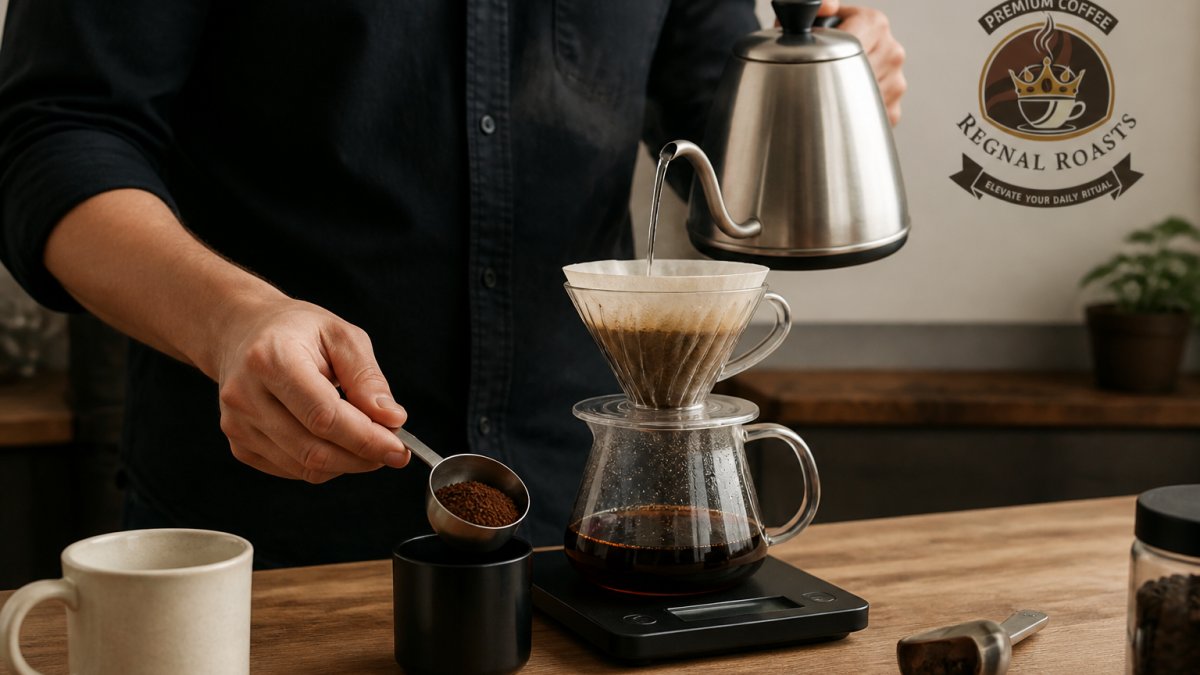
Pour-over gives you control: hot water over grounds in a filter, gravity does the work. It takes five to ten minutes and yields clean, bright coffee.
A pour-over setup needs just a dripper, a filter, and a cup.
Heat water to 195 to 205 degrees Fahrenheit and use a medium-fine grind. Pour slowly, letting the water soak the grounds first, this bloom releases gases and improves extraction.
French Press
A French press steeps grounds in hot water, then you press a metal filter down to separate liquid from grounds. The metal filter lets oils through, so the result is rich and full-bodied.
Use a coarse grind: fine grounds slip through the metal filter and cloud your cup.
Brew for four minutes: add hot water (195 to 205 degrees Fahrenheit), stir after one minute, then press slowly.
AeroPress and Moka Pot
An AeroPress is a plastic cylinder with a plunger: add grounds and hot water, wait a minute or two, then press down, forcing water through a paper filter for a smooth, clean result.
Use a medium grind; the process takes about three minutes. AeroPress is portable, durable, and makes excellent coffee.
A Moka pot brews on the stovetop. Water in the bottom chamber heats and creates pressure that forces hot water up through ground coffee into the top chamber. Use a fine grind.
Cold Brew and Espresso
Cold brew steeps coarse grounds in room-temperature water for 12 to 24 hours for a smooth, less acidic result. The concentrate keeps two weeks in the refrigerator.
Espresso uses high pressure to force hot water through finely ground coffee in seconds. It requires a machine and practice, but the payoff is a rich, intense shot.
Coffee Grind Size for Brewing: The Foundation of Flavor
Grind size controls how fast water moves through the grounds, which affects extraction and flavor.
Think of grind size as a spectrum. Coarse grinds have large particles. Fine grinds are powder-like.
Use coarse grind for French press and cold brew, medium for drip machines and pour-over, and fine for espresso and Moka pot.
Grind beans at home just before brewing, pre-ground coffee loses flavor within hours.
Consistency matters more than perfection: uneven grinds extract unevenly, some particles bitter and others sour.
Master the Coffee-to-Water Ratio
The coffee-to-water ratio determines strength and flavor balance. Most home brewers guess with spoons, so results swing from cup to cup; a repeatable baseline fixes that.
Start With a Weight-Based Baseline
Weigh coffee and water in grams instead of scooping. Volume varies with grind size, bean density, and packing, a tablespoon of fine espresso grind and one of coarse French press grind can differ by several grams.
A common baseline is 1 gram of coffee to 16 grams of water (1:16), roughly 60 grams per liter, or 18 grams for a 10-ounce (300-gram) cup. That lands in the balanced range most drinkers find pleasant; adjust from there deliberately.
Method-Specific Starting Parameters
Use these as your first brew, then tune to taste. Ratios are by weight and times are total contact time.
| Method | Coffee:Water | Dose (for ~10 oz cup) | Grind | Water Temp | Brew Time |
|---|---|---|---|---|---|
| Drip machine | 1:16 to 1:17 | 18 g | Medium | 195-205°F | 4-6 min |
| Pour-over (V60/Chemex) | 1:15 to 1:16 | 18-20 g | Medium-fine | 195-205°F | 2.5-4 min |
| French press | 1:12 to 1:15 | 20-24 g | Coarse | 195-205°F | 4 min steep |
| AeroPress | 1:12 to 1:15 | 15-18 g | Medium-fine | 185-200°F | 1.5-2.5 min |
| Moka pot | 1:10 to 1:12 | fill basket level | Fine | preheated water | until sputter |
| Cold brew | 1:5 concentrate | 100 g per 500 g water | Coarse | room temp | 12-18 hr |
| Espresso | 1:2 (dose:yield) | 18 g in, 36 g out | Fine | 200-205°F | 25-30 sec |
Espresso is measured differently: compare the dry dose to the liquid yield in the cup, not the reservoir water. An 18-gram dose pulling 36 grams in 25-30 seconds is a standard start.
Adjust One Variable at a Time
If your coffee tastes weak, don't change everything at once. Move one lever a small step, then taste again.
- Too weak or thin: increase dose by 1-2 grams, or tighten the ratio toward 1:15.
- Too strong or harsh: decrease dose by 1-2 grams, or loosen the ratio toward 1:17.
- Sour and weak together: the grind is likely too coarse, go finer before adding more coffee.
- Bitter and strong together: the grind is likely too fine, go coarser before cutting the dose.
Strength (how much coffee you use) and extraction (how much flavor you pull out) often get confused. Adding coffee makes a cup stronger but won't fix sourness from under-extraction: grind fixes extraction, dose fixes strength. Change one, taste, then decide.
Keep a Simple Log
Log four things per brew: dose in grams, water in grams, grind setting, and total brew time, plus one word for taste.
Best Water Temperature for Coffee Extraction
Water temperature controls extraction speed. The right temperature pulls out sweetness and complexity. Wrong temperature creates sour or bitter coffee.
Aim for 195 to 205 degrees Fahrenheit for most brewing methods, and use a simple thermometer to check.
Without a thermometer, let boiling water cool about 30 seconds to land in the right range.
Water quality matters too: mineral content affects extraction.
Troubleshoot Common Brewing Problems
Most flavor problems trace back to extraction, how much soluble material the water pulled out. Under-extraction leaves sour, salty, thin flavors; over-extraction pulls out bitter, dry, ashy compounds. Strength is a separate axis: how much coffee you used relative to water. Diagnosing the axis tells you which variable to change.
Read the Cup Before You Change Anything
Taste and ask two questions: sour or bitter? Weak or strong? Sour and bitter point to extraction; weak and strong point to dose and ratio.
| What You Taste | Likely Cause | First Fix | If That Fails |
|---|---|---|---|
| Sour, sharp, salty | Under-extraction | Grind finer | Raise water temp 2-3°F, then extend brew time |
| Bitter, dry, ashy | Over-extraction | Grind coarser | Lower water temp 2-3°F, then shorten brew time |
| Weak and watery | Too little coffee | Increase dose 1-2 g | Tighten ratio toward 1:15 |
| Strong and harsh | Too much coffee | Decrease dose 1-2 g | Loosen ratio toward 1:17 |
| Muddy, silty | Fine particles in cup | Grind coarser | Switch to a paper filter |
| Flat, cardboard, stale | Old or oxidized beans | Buy beans roasted within 2-4 weeks | Store airtight, away from heat and light |
| Inconsistent cup to cup | Uneven grind or dose | Use a burr grinder and a scale | Weigh every brew, not just some |
How the Variables Interact
Grind size, water temperature, brew time, and dose all push extraction the same direction: finer grind, higher temperature, longer brew, or more coffee all increase extraction. Change only one at a time so you can tell what worked.
- Grind size is the strongest lever. One or two clicks finer or coarser usually shifts flavor more than a few degrees of temperature.
- Water temperature is a fine-tuning lever. Move it 2-3°F at a time, not 10.
- Brew time matters most in immersion methods like French press and AeroPress, where the grounds sit in water. In drip and pour-over, grind size and pour speed dominate.
- Dose changes strength more than extraction. Adding coffee makes the cup stronger, but if it is sour, the fix is grind, not more coffee.
Match the Fix to the Method
A muddy French press is usually a grind problem, the metal mesh lets fines through, so go coarser or switch to paper. A pour-over that drains fast and tastes sour needs a finer grind or slower pour, not more coffee. A flat drip machine may not be reaching 195°F; check the carafe with a thermometer. A bitter AeroPress is often over-steeped, cut the steep to 60-90 seconds and press gently.
When the Problem Is the Bean, Not the Brew
If every method tastes flat or papery, the issue is upstream: beans roasted more than four weeks ago, stored in the refrigerator where condensation forms, or pre-ground and open for weeks will taste stale no matter how well you brew. Fix the bean first, then dial in the brew.
Maintenance and Storage for Consistent Results
Clean your brewing equipment regularly. Oil and old coffee residue build up and create stale flavors.
Rinse your dripper or French press right after brewing. Use hot water and a soft brush.
For espresso machines and Moka pots, follow the manufacturer's instructions. These tools have more moving parts and need careful cleaning.
A sealed jar or canister works well; label it with the roast date.
Grind beans just before brewing: ground coffee loses flavor fast, while whole beans stay fresh much longer.
How to Brew Better Coffee: Your Action Plan
To brew better coffee comes from small, deliberate changes. You don't need expensive equipment or rare beans.
Start here:
- Buy fresh beans roasted within the last two to four weeks
- Grind your beans at home, just before brewing
- Use filtered water heated to 195 to 205 degrees Fahrenheit
- Measure your coffee and water with a scale
- Choose a brewing method that fits your routine
- Keep notes on what tastes good
These steps alone transform your daily cup. Experiment with grind size and brew time. Small adjustments reveal new flavors.
According to specialty coffee industry standards, proper extraction produces coffee with balanced acidity, sweetness, and body. This is achievable at home with attention to these fundamentals.
Our Breakfast Blend at Regnal Roasts is crafted to work across multiple brewing methods.
Brewing better coffee at home is entirely within reach. Subscribe to our emails to discover new roasts, brewing tips, and exclusive offers that elevate your daily ritual.
Frequently Asked Questions
What is the best coffee-to-water ratio for home brewing?
The standard ratio is 1:16 (one part coffee to 16 parts water by weight), which works for most brewing methods and produces a balanced cup. For stronger coffee, use 1:15; for lighter coffee, try 1:17. Measure by weight using a kitchen scale for consistency. Adjust based on your taste preference and the specific brewing method you choose.
How does coffee grind size affect the flavor of my brew?
Grind size controls how quickly water extracts flavor from the grounds. Finer grinds extract faster (use for espresso and AeroPress), while coarser grinds extract slower (use for French press and cold brew). Too fine causes over-extraction and bitter taste; too coarse causes under-extraction and weak, sour coffee. Match your grind size to your brewing method for optimal results.
What water temperature should I use to brew coffee?
Brew coffee between 195-205°F for best extraction. Water that is too hot (over 205°F) over-extracts and creates bitter flavors; water that is too cool (below 195°F) under-extracts and produces weak, sour coffee. If you don't have a thermometer, let boiling water cool for 30 seconds before brewing. Consistent temperature across brewing methods ensures balanced flavor.
How fresh should coffee beans be when I brew them?
Use whole beans within 2-4 weeks of the roast date for peak flavor and aroma. Freshly ground coffee (ground just before brewing) preserves more complexity than pre-ground. Store beans in an airtight container away from light, heat, and moisture to maintain freshness longer. Regnal Roasts' fresh roasted blends deliver the depth and distinction you need for exceptional home brewing.