

Why Artisanal Coffee Tastes Better: A 2026 Guide
Table of Contents
- The Science Behind Why Artisanal Coffee Tastes Better
- Fresh Roasted Coffee Beans: Why Roast Date Changes Everything
- The Benefits of Small-Batch Coffee Roasting
- How to Brew Artisanal Coffee at Home Without a Cafe Budget
- Equipment Maintenance and Cleaning: The Upgrade Nobody Talks About
- Budget-Friendly Upgrades That Make Artisanal Coffee Taste Better
- Frequently Asked Questions
Last Updated: September 16, 2026
The Science Behind Why Artisanal Coffee Tastes Better
Artisanal coffee tastes better because it is roasted in small batches close to the brew date, preserving aromatic compounds industrial coffee loses during long storage and mass production. This guide from Regnal Roasts breaks down what changes in the cup and how to get those results at home.
Most grocery-aisle coffee was roasted months ago. By the time it reaches a brewer, the volatile oils responsible for aroma have oxidized, leaving a flat, bitter cup. Freshness is the single largest variable separating a remarkable cup from an average one.
Below, we'll show how roast date, grind consistency, water chemistry, and equipment care shift flavor, and which upgrades deliver the biggest difference for the least money.
Fresh Roasted Coffee Beans: Why Roast Date Changes Everything
Fresh roasted coffee beans peak roughly 4 to 14 days after roasting, once they finish degassing but before oxidation dulls their aromatic compounds. That window is the argument for small-batch coffee over supermarket stock.
Beans release carbon dioxide for days after roasting. Too much gas disrupts even extraction; too little means the bean has begun to stale. Roasters who print a roast date, not just a best-by date, give you what you need to time your brewing.
"Fresh" and "recently packaged" are not the same claim. A bag can be sealed last week from beans roasted eight months ago. The roast date is the only number that tells you the truth.
The Benefits of Small-Batch Coffee Roasting
Small-batch roasting gives a roaster control to develop a specific profile for each origin, rather than flattening every bean into one uniform, dark result, producing distinct tasting notes instead of generic "coffee" flavor.
In large commercial operations, volume dictates consistency: beans from many farms are blended and roasted to one specification so the product tastes identical everywhere, and origin character disappears. Small-batch roasting moves the opposite direction, a Colombian lot can be roasted to highlight dried orange and chocolate notes, an Ethiopian natural separately to preserve its fruit-forward sweetness.
What a Roast Profile Actually Controls
A roast profile is the record of how bean temperature changes over time, and it is the biggest lever a roaster has over flavor. Three points matter most:
- Charge and drying phase. The first minutes drive off moisture. How fast the beans dry sets up everything that follows.
- First crack. Around 385°F to 400°F bean temperature, moisture and gas inside the bean force the structure open with an audible crack. This is the boundary between a light and a medium roast.
- Development time. The stretch after first crack, usually measured as a percentage of total roast time, builds body and sweetness. Too short and the cup tastes grassy and underdeveloped; too long and roast flavor crowds out origin character.
A small-batch roaster can adjust each point for a single lot, tasting and re-roasting until the profile flatters that bean.
Why Roast Date and Roast Level Interact
Freshness and roast level are not independent. A light roast retains more origin acids and aromatics but degasses faster and can taste sharp if brewed too soon. A darker roast has more developed sugars and body, but roast flavors dominate and more surface oils change how it stales.
Blend Versus Single Origin: A Choice, Not a Ranking
That is why two coffees from the same company can taste completely different, and why a single origin and a blend each have a place in your rotation. The 6 Bean Blend is built for balance and body, drawing on six origins for a rich, full-bodied dark roast. Bali Blue showcases one place and one process: smallholder farms in Kintamani, wet-hulled and dried on raised beds, with notes of dark chocolate, molasses, and brown sugar.

How to Brew Artisanal Coffee at Home Without a Cafe Budget
You can brew artisanal coffee at home without a cafe budget by controlling four variables: grind consistency, water temperature, brew ratio, and agitation. Nail those, and a modest setup outperforms a careless expensive one.
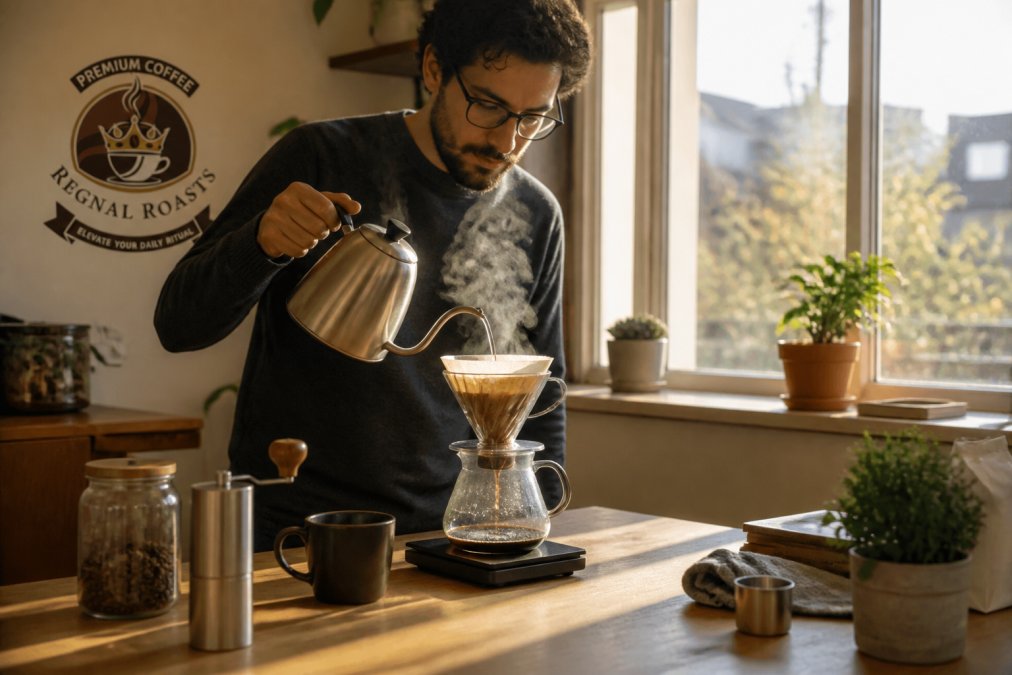
- Weigh your coffee. A kitchen scale costs little and fixes the biggest source of inconsistency.
- Use a brew ratio of roughly 1:16, one part coffee to sixteen parts water by weight. For a 12-ounce mug, that is about 22 grams of coffee to 355 grams of water.
- Heat water to between 195°F and 205°F. Water that is too hot pulls out bitterness; too cool leaves the cup sour and thin.
- Grind fresh, and grind consistently. An uneven grind means some particles over-extract while others under-extract.
- Bloom the grounds first. Pour about twice the coffee's weight in water, wait 30 to 45 seconds for trapped gas to escape, then continue pouring.
- Pour slowly and evenly to avoid channeling, where water finds a single path through the bed and leaves the rest of the coffee under-extracted.
Water Chemistry: The Mineral Content Most Brewers Ignore
Water chemistry is the variable almost every home brewer overlooks. Coffee is roughly 98 percent water, so its minerals directly shape what you taste, yet most guides say "use filtered water" and stop, without explaining which minerals matter.
Grind Consistency and Equipment: Where Cheap Gear Actually Costs You
Grind consistency is the second variable most home brewers underestimate. A blade grinder chops beans into powder and boulders; the powder over-extracts into bitterness while the boulders under-extract into sourness, and no technique fixes that. A burr grinder crushes beans to a uniform size, the foundation of even extraction.
A Realistic Low-Cost Upgrade Path
If you are starting from scratch, spend in this order and stop when the cup is good enough for you:
- First, buy fresh whole bean coffee with a printed roast date. This is the upgrade that compounds everything else.
- Second, add a kitchen scale. It costs little and eliminates the guesswork that ruins most home brews.
- Third, fix your water. A carbon filter or a gallon of coffee-specific water is cheap and high-impact.
- Fourth, buy a burr grinder. Even a hand grinder beats a blade grinder.
- Fifth, add a temperature-controlled kettle.
Equipment Maintenance and Cleaning: The Upgrade Nobody Talks About
Cleaning your equipment is the highest-return, lowest-cost upgrade in coffee. Oils from roasted beans build up on every surface they touch, and those stale oils turn rancid, adding bitterness no fresh bean can overcome.
- Rinse your dripper or pour-over cone after every brew.
- Wash your carafe and mug daily with hot water and a mild soap.
- Brush out your grinder's burrs weekly to clear retained grounds.
- Descale your kettle monthly using a vinegar or citric acid solution.
- Deep-clean your espresso machine or drip brewer on the schedule the manufacturer specifies.
Budget-Friendly Upgrades That Make Artisanal Coffee Taste Better
The upgrades that improve artisanal coffee the most are not the most expensive ones. A burr grinder, a scale, and better water will change your cup more than a costly machine.
Prioritize in this order:
| Upgrade | Why It Matters | Approximate Cost |
|---|---|---|
| Burr grinder | Consistent particle size for even extraction | Low to mid |
| Kitchen scale | Accurate brew ratio and repeatable results | Low |
| Filtered water | Balanced mineral content for clear flavor | Low |
| Gooseneck kettle | Controlled pour and steady temperature | Mid |
| Fresh whole bean coffee | Preserves aromatic compounds and oils | Ongoing |
Frequently Asked Questions
Why does coffee shop coffee taste so much better than what I make at home?
Cafes control variables most home brewers overlook: water temperature within a degree or two, a precise brew ratio, and beans used within days of roasting. They also grind immediately before brewing with a burr grinder, which keeps grind consistency even. You can close most of that gap at home by weighing your coffee, using filtered water at 195-205F, and buying fresh roasted coffee beans with a visible roast date instead of a best-by date.
How does roast date affect the flavor of coffee?
Coffee degasses carbon dioxide for several days after roasting, and those gases interfere with even extraction. Too fresh and the cup tastes flat or sharp; too old and oxidation dulls the aromatic compounds, leaving bitterness and a papery note. Most artisanal roasters recommend a rest of 4 to 14 days after the roast date, then drinking within 2 to 4 weeks. That window is why fresh roasted coffee beans outperform supermarket bags that sat on a shelf for months.
Is artisanal coffee worth the higher price point?
It depends on what you are comparing. A $1,200 annual habit built on commodity pods works out to roughly $3.30 a day. Regnal Roasts' 6 Bean Blend and single origins are priced at $158.02 per bag, and because you control the dose, the cost per cup stays predictable while you gain roast dates, origin transparency, and tasting notes. If you drink coffee daily and notice flavor, the difference in the cup justifies the spend.
What makes small-batch roasting different from industrial roasting?
Small-batch roasting lets a roaster adjust time and temperature to a specific bean's density, moisture, and origin. Industrial operations roast in much larger volumes and often push darker profiles so flavor stays consistent across batches. The benefits of small-batch coffee roasting show up as a more distinct roast profile, preserved sweetness and acidity, and tasting notes that reflect the coffee bean origin rather than the roaster's need for uniformity.