

Don Francisco vs Fresh Roasted Coffee: The Real Difference
Table of Contents
- What Sets Fresh Roasted Coffee Apart from Supermarket Brands
- Roast Date Transparency and Coffee Freshness After Roasting
- Flavor, Aroma, and Taste Profile Differences
- How to Store Coffee Beans to Preserve Quality
- Best Coffee for Drip Coffee Makers: Don Francisco vs Fresh Roasted
- Price Per Cup and Value Comparison
- Packaging, Recyclability, and Environmental Considerations
- Which Option Is Right for Your Routine
- Frequently Asked Questions
Last Updated: October 20, 2026
What Sets Fresh Roasted Coffee Apart from Supermarket Brands
The difference between fresh roasted coffee and supermarket brands like Don Francisco comes down to time.
Coffee is perishable: the aromatic oils and volatile compounds that create complexity, brightness, and depth degrade through oxidation and degassing.
At Regnal Roasts, our handcrafted coffee blends are crafted to deliver a superior taste experience that reigns supreme.
The flavor profile speaks loudest. Fresh roasted beans deliver vibrant acidity, pronounced tasting notes, and aromatic intensity supermarket coffee cannot match after months on a shelf, with a fuller body and lingering finish.
Roast Date Transparency and Coffee Freshness After Roasting
Understanding the Peak Window
Coffee reaches its optimal flavor window roughly 5-14 days after roasting, depending on roast level and bean density. Light roasts peak faster and decline quicker; dark roasts have a slightly wider window.
Bagged whole-bean coffee is most expressive in the first two to four weeks after roast, then declines gradually. Pre-ground coffee moves through that window much faster because more surface area is exposed to oxygen.
How to Find and Read a Roast Date
Roast dates appear in several places, and knowing where to look is half the battle:
- Printed on the bag, often as a stamp or inkjet code. Look on the back panel, the bottom gusset, or near the one-way valve. Formats vary: "Roasted on 10/02/26," "RO 10/02/26," or a Julian-style code such as "26102" (year 26, day 102).
- A "best by" date only. If that is all you see, you cannot calculate roast age directly. Many commercial brands use a best-by window of several months, which tells you the coffee was designed for shelf stability rather than peak freshness.
- A lot code or batch number. Some brands print a production code a customer-service line can translate into a roast date.
- No date at all. Common on value-tier supermarket bags. Treat undated coffee as a sign that freshness is not the brand's priority.
Don Francisco vs Fresh Roasted: Roast Date Clarity
Don Francisco, owned by Westrock Coffee Company, is a major commercial brand. Many bags include a best-by date; some also carry a production or lot code.
Fresh roasted coffee from specialty roasters usually prints an explicit roast date and often ships within a few days of roasting. Some roasters let you choose a roast date at checkout, turning freshness from a guess into a known quantity.
A Practical Freshness Check
You can verify freshness at home without special equipment:
- Note the date on the bag and write it on the container you transfer the beans into.
- Smell the bag when you open it. Fresh whole beans release a pronounced, specific aroma. Flat or papery smells suggest the coffee is past its peak.
- Watch the bloom. When hot water hits fresh grounds, trapped carbon dioxide escapes and the bed puffs up. A vigorous bloom is a rough sign of recent roasting; a weak or absent bloom suggests older coffee.
- Taste at day 3, day 10, and day 21 after opening. Most drinkers notice the cup getting flatter and less aromatic by the third check.
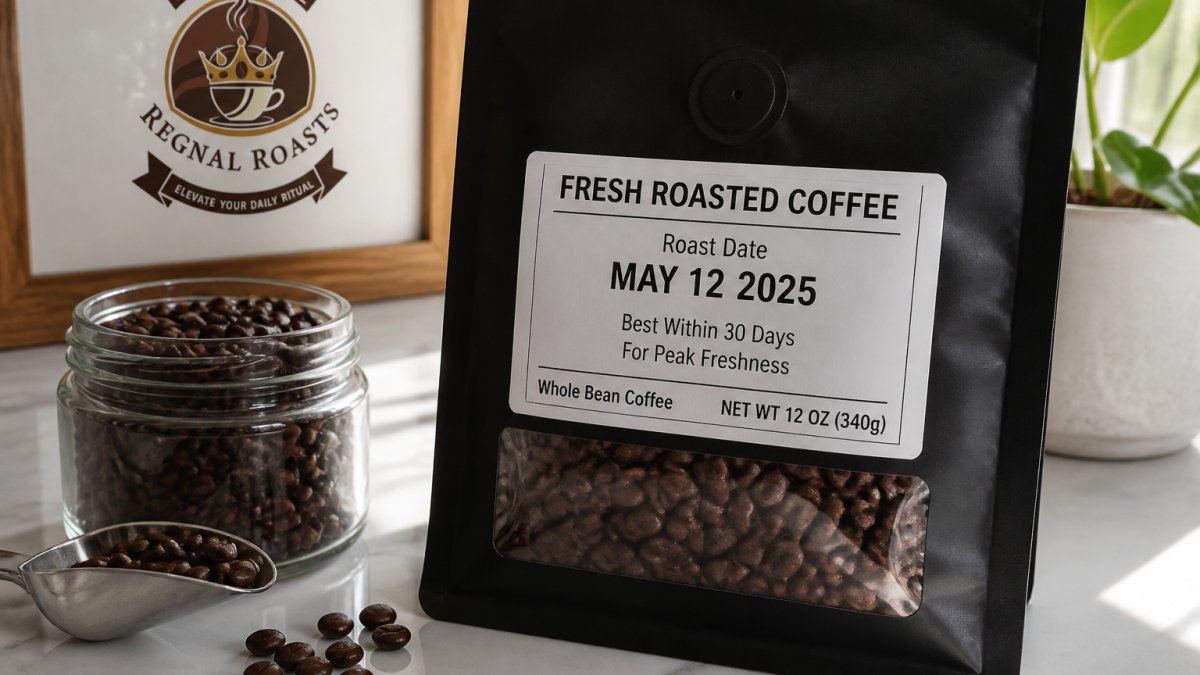
The takeaway is not that one brand is dishonest and another is honest. A roast date gives you a decision-making tool, and a best-by date does not. If freshness matters, buy from sellers who tell you when the coffee was roasted and ship close to that date.
Flavor, Aroma, and Taste Profile Differences
Fresh roasted coffee delivers noticeably more aroma.
That aromatic intensity translates to flavor: brighter and more textured, with distinct layers that evolve as the cup cools. Supermarket coffee tastes flatter because the volatile compounds that create nuance have already oxidized away.
Acidity is where the difference becomes most obvious. Fresh roasted coffee, especially lighter roasts, has pronounced acidity that feels clean and crisp, not sour.
Body and mouthfeel also shift with age. Fresh roasted coffee feels heavier and more syrupy at the same grind and brew settings, thanks to oils still present in the beans.
How to Store Coffee Beans to Preserve Quality
Storage determines how quickly your coffee declines after opening. The enemies are oxygen, light, heat, and humidity. An airtight container in a cool, dark place slows degradation significantly; refrigerators and freezers introduce moisture and temperature fluctuations that damage beans.
Store beans in an airtight container away from direct sunlight; a cupboard or pantry works perfectly. Once opened, most coffee stays at good quality for 2-3 weeks if stored properly, then the flavor noticeably flattens.
Whole Bean vs Pre-Ground: Storage Implications
Whole bean coffee stays fresher longer because less surface area is exposed to oxygen. Pre-ground coffee has vastly more surface area, so it stales much faster, often within days of grinding.
Whole bean is always preferable if you can grind it. A basic burr grinder costs $30-50: grind just before brewing to capture the aromatic compounds that would otherwise escape during storage.
Don Francisco offers both whole bean and pre-ground options. The pre-ground convenience comes at a flavor cost.
Best Coffee for Drip Coffee Makers: Don Francisco vs Fresh Roasted
Drip coffee makers are forgiving, which is why supermarket brands dominate this category, but they also reveal differences clearly.
Grind size matters most for drip brewing, and medium-fine is standard. Fresh roasted coffee grinds more uniformly because the beans are denser and less brittle, improving extraction and reducing over-extraction bitterness.
Don Francisco coffee works fine in drip makers, which is what it's formulated for, but it won't deliver the complexity or brightness fresh roasted coffee can provide.
For best results in a drip maker, use filtered water heated to 195-205°F, a 1:16 coffee-to-water ratio by weight, and brew for 4-5 minutes.
Price Per Cup and Value Comparison
The cost conversation requires honesty, and it requires arithmetic. Price per pound is a starting point, but price per cup is what actually hits your budget. The formula is simple:
Cost per cup = (bag price ÷ bag weight in ounces) × ounces used per cup
A standard mug of drip coffee uses about 0.4-0.6 ounces of ground coffee by weight, depending on strength preference and brew ratio. At a 1:16 coffee-to-water ratio, a 12-ounce cup uses roughly 0.75 ounces of coffee; many home brewers use closer to 0.5 ounces for a milder cup. We will use 0.5 ounces as a middle estimate below.
Worked Examples
| Coffee type | Typical bag size | Typical price | Ounces per cup | Approx. cups per bag | Approx. cost per cup |
|---|---|---|---|---|---|
| Don Francisco ground or whole bean | 12 oz | $8-$12 | 0.5 | 24 | $0.33-$0.50 |
| Don Francisco larger club-size bag | 24-30 oz | $14-$20 | 0.5 | 48-60 | $0.23-$0.42 |
| Fresh roasted whole bean, specialty | 12 oz | $14-$18 | 0.5 | 24 | $0.58-$0.75 |
| Fresh roasted whole bean, premium single origin | 12 oz | $18-$24 | 0.5 | 24 | $0.75-$1.00 |
These are illustrative ranges based on common retail pricing; actual prices vary by retailer, region, and promotions. The point is the shape of the difference: the gap between a value supermarket bag and a specialty fresh-roasted bag is often 25-50 cents per cup, not dollars. For one cup a day, that is roughly $90-$180 a year at the high end of the gap.
What You Are Paying For
The premium buys three things: freshness (a shorter time from roast to your door), traceability (roast dates, origin information, and often lot details), and consistency of roast profile. It does not automatically buy better green coffee. A well-run commercial brand can source solid beans; a careless specialty roaster can sell mediocre coffee at a premium. Price per cup is a useful filter, not a guarantee.
Where the Math Flips
- Single-serve pods. Pods usually cost more per cup than bagged coffee, often 50 cents to $1.25 per pod depending on brand and format. Convenience is the product; the coffee is secondary.
- Pre-ground vs whole bean. At the same bag price, pre-ground coffee often needs a slightly higher dose to reach the same strength because it extracts differently and stales faster. The per-cup cost creeps up even when the sticker price does not.
- Wasted coffee. A bag that goes stale before you finish it effectively raises your cost per good cup. Buying smaller bags more often can beat a large discount bag you cannot finish.
Regnal Roasts positions itself in the premium fresh roasted category. K-Cup compatible pods offer convenience at a cost premium compared to whole beans. The trade-off is speed and simplicity versus the freshness advantage of whole bean and the control of grinding your own.
Packaging, Recyclability, and Environmental Considerations
Don Francisco uses traditional coffee bag packaging, typically with a one-way valve and foil lining. These bags are recyclable in some programs but not universally.
Fresh roasted coffee roasters vary in packaging philosophy: some use similar foil bags, others compostable or recyclable materials, as specialty roasters increasingly prioritize sustainability.
Regnal Roasts K-Cup compatible pods present a sustainability consideration. Single-serve pods are convenient but generate plastic waste.
Transportation matters too: fresh roasted coffee shipped directly to consumers typically travels fewer miles than supermarket coffee distributed through regional warehouses, which can offset some packaging concerns.
Which Option Is Right for Your Routine
Choose Don Francisco if you prioritize consistency, convenience, and cost. It's available everywhere, tastes familiar, and represents solid value for casual coffee drinkers.
Choose fresh roasted coffee if you're willing to pay a small premium for noticeably better flavor, aroma, and freshness.
The decision comes down to how seriously you take your morning coffee. If it's fuel, Don Francisco works fine. If it's a daily ritual, fresh roasted coffee transforms the experience.
For those seeking both convenience and premium quality, Regnal Roasts offers handcrafted coffee blends in K-Cup compatible pods.
The real difference between Don Francisco and fresh roasted coffee isn't complicated, it's time. Regnal Roasts delivers handcrafted blends. Explore our collection of unique, bold roasts and discover what superior taste experience actually feels like.
Frequently Asked Questions
What is the actual difference between Don Francisco coffee and fresh roasted coffee?
Don Francisco coffee is a mass-market supermarket brand with a longer shelf life and less roast-date transparency. Fresh roasted coffee is roasted in small batches with a known roast date, typically within 1-2 weeks of purchase. Fresh roasted coffee retains more aromatic compounds, brightness, and complexity because it hasn't spent months in storage. Don Francisco offers consistency and convenience; fresh roasted delivers peak flavor and aroma but requires attention to storage and use within a narrower window.
How long does coffee stay fresh after roasting?
Coffee peaks in flavor 5-10 days after roasting and remains excellent for 2-4 weeks. After 4 weeks, oxidation and degassing reduce brightness and aroma. Whole beans stay fresh longer than pre-ground coffee because grinding exposes more surface area to oxygen. Proper storage in an airtight container away from light and heat extends freshness. Most fresh roasted coffee roasters print the roast date on the bag so you can track how old your beans are.
Is fresh roasted coffee healthier than packaged supermarket coffee?
Fresh roasted and packaged coffee contain similar caffeine levels and antioxidants. The main difference is freshness: fresh roasted coffee retains more volatile compounds and aromatic oils that contribute to taste and perceived richness. Some coffee enthusiasts report that fresher coffee feels smoother and less bitter, which may reduce the desire to add sweeteners or cream. Neither is inherently healthier; the choice depends on your preference for flavor intensity and your brewing method.
What brewing method works best with fresh roasted coffee?
Fresh roasted coffee shines in drip coffee makers, pour-overs, and French presses because these methods extract the full range of flavors and aromas. For drip machines, use a medium grind and brew at 195-205°F. Pour-overs and French presses give you more control over water temperature and contact time, allowing you to highlight the bean's origin characteristics and roast profile. Espresso also works well but requires a grinder that handles fresh beans without clogging. Avoid letting brewed fresh roasted coffee sit for more than 30 minutes before drinking to preserve aroma.