

What Is a Sensory Coffee Experience? A 2026 Guide
Table of Contents
- What Is a Sensory Coffee Experience?
- The Science Behind Aroma, Taste, and Mouthfeel
- Your Coffee Tasting Notes Guide for Beginners
- How to Perform a Coffee Cupping at Home
- Mindful Coffee Drinking Habits That Deepen Flavor
- How Vessels, Color, and Environment Shape Perception
- Sensory Training Exercises for Home Baristas
- Frequently Asked Questions
Last Updated: September 29, 2026
What Is a Sensory Coffee Experience?
A sensory coffee experience is the full, deliberate engagement of sight, smell, taste, touch, and even hearing while drinking coffee, rather than treating it as a caffeine delivery mechanism. At Regnal Roasts, we build every blend around that idea: coffee worth slowing down for. Below, we'll show you exactly how aroma, flavor, mouthfeel, and setting combine into one perceptual event, and how to train your own palate to notice the difference.

The Five Senses at Work in Every Cup
Every cup is a multisensory event. Your eyes judge color and crema before you sip. Your nose catches volatile compounds released the moment hot water hits the grounds. Your tongue and palate register sweetness, acidity, and bitterness, while your hands feel the warmth of the vessel. Even the sound of the pour shapes expectation. Ignore any one channel and the perceptual experience flattens.
The Science Behind Aroma, Taste, and Mouthfeel
What most people call "taste" is mostly smell. The olfactory system handles aroma, while the gustatory system handles the five basic tastes: sweet, sour, salty, bitter, and umami. Coffee engages both, plus touch, which is why a single sip can feel layered rather than flat. But the real story is what happens after the signal leaves your tongue and nose, because the brain, not the cup, assembles the experience.
The Neurobiology of a Single Sip
When you sip coffee, three separate nerve pathways fire at once. Taste buds on the tongue send signals through the chorda tympani and glossopharyngeal nerves. Aroma compounds travel two routes: orthonasal (through the nostrils before you sip) and retro-nasal (up the back of the throat as you swallow). Meanwhile, the trigeminal nerve, the same one that registers the burn of chili or the cool of menthol, carries tactile and thermal information from the mouth, including the mild astringency of coffee's chlorogenic acids and the warmth of the liquid.
Aroma and Retro-Nasal Olfaction
Retro-nasal olfaction is the process of aroma compounds traveling from the back of your mouth up into your nasal cavity as you swallow. It's the reason a coffee can smell like caramel and then taste like caramel. Volatile compounds released during extraction carry these tasting notes, and they're most active while the coffee is hot but not scalding. Let a cup cool for a minute before judging it.
Mouthfeel, Body, and Tactile Perception
Mouthfeel is the tactile sensation of coffee on your tongue, palate, and throat. Body describes its weight: light and tea-like, or heavy and syrupy. A Brazilian medium roast often lands fuller on the palate than a bright East African light roast, and that difference is texture, not flavor. Your palate reads it through nerve endings tuned to pressure and temperature, which is why thermal perception matters.
Your Coffee Tasting Notes Guide for Beginners
A coffee tasting notes guide gives you vocabulary for what you're already sensing. Start with four axes, then build outward:
- Acidity: the bright, lively quality, not sourness. Citrus, berry, or wine-like.
- Sweetness: caramel, honey, brown sugar, or fruit. Most noticeable as coffee cools.
- Body: light, medium, or full. Think skim milk versus cream.
- Aftertaste: what lingers 30 seconds after you swallow. A clean finish or a dry one.
How to Perform a Coffee Cupping at Home
Coffee cupping is the standardized tasting method professionals use to evaluate aroma, flavor profile, acidity, body, and aftertaste side by side. You can run a simplified version at home in about 20 minutes with tools you already own, and it's the fastest way to build real sensory vocabulary.
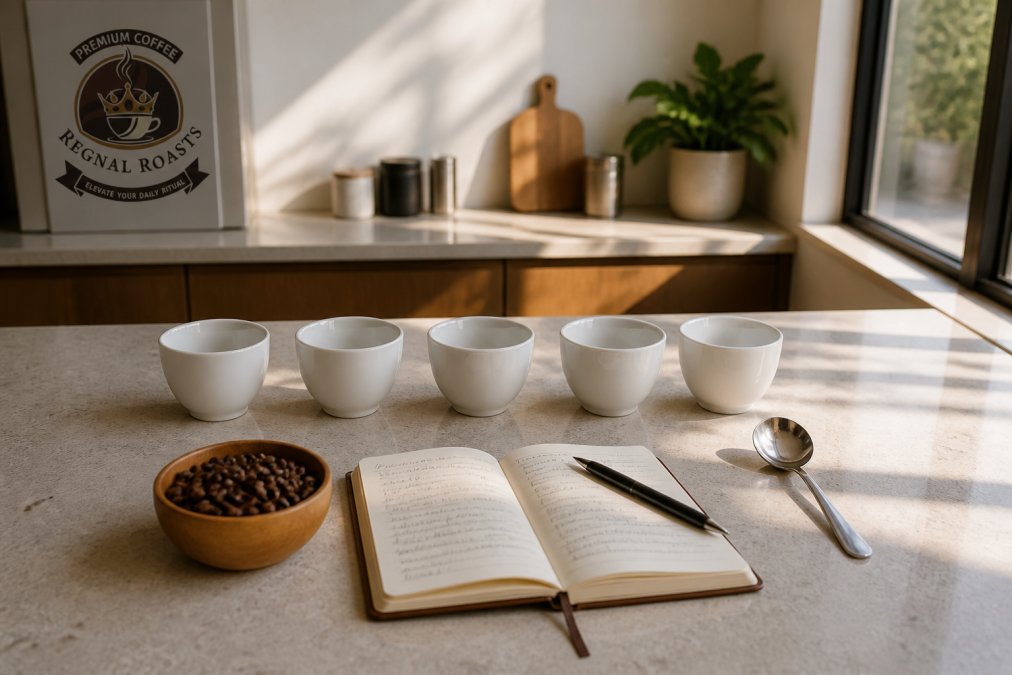
Step-by-Step Cupping Setup and Slurping Technique
- Weigh and grind. Use equal amounts of each coffee, ground medium-coarse. If you're comparing blends, a single origin favorites sample pack makes this easy, since each 2oz pouch is a different origin.
- Heat your water. Just off the boil, poured over the grounds in each cup.
- Smell the crust. Wait four minutes, then break the floating layer of grounds with a spoon and inhale directly above it.
- Skim and cool. Remove the grounds and let the cups rest until they're warm rather than hot.
- Slurp from a spoon. Take a small amount and draw it in sharply with air.
- Score and compare. Note acidity, sweetness, body, and aftertaste for each cup before moving on.
Expected result: within two or three sessions, you'll reliably separate a bright Ethiopian roast from a smooth Brazilian one without reading the label.

Mindful Coffee Drinking Habits That Deepen Flavor
Mindful coffee drinking is the practice of removing distractions for the first few minutes of your cup so your attention can actually register what you're tasting. The habit costs nothing and changes everything.
How Vessels, Color, and Environment Shape Perception
Vessel design and visual cues change how coffee tastes before a drop touches your tongue. A wide, thin-rimmed cup spreads the liquid across more of your palate and cools it faster. A thick-walled mug holds heat longer and feels cozier in the hand, which shifts your thermal perception and, with it, how sweet the coffee reads.
The Visual Psychology of Color and Light
Color is the most underrated variable in coffee perception, and almost no guide covers it seriously. The mechanism is expectation: your brain predicts flavor from visual cues before the first sip, and then filters the actual taste signal to match the prediction. This is a form of cognitive bias in taste perception, and it is well documented in food and beverage research, people reliably rate identical drinks differently based on container color.
Applied to coffee, a few patterns hold:
- White interiors show the true color of the brew, which helps you judge roast level and extraction. They also tend to make coffee read as brighter and more acidic.
- Dark or colored interiors hide the brew's color and can push perception toward "richer" or "sweeter," even when the liquid is identical.
- Warm-toned mugs (terracotta, amber, cream) tend to reinforce sweetness expectations; cool tones (blue, gray) can nudge perception toward bitterness or clarity.
The Social and Ritual Context
Environment is not just physical, it is social. The same coffee scored in a silent cupping lab and shared at a kitchen table is not the same perceptual event. Social context sets expectation and attention: when someone hands you a cup and tells you what to look for, you find it. When you drink alone while working, you find almost nothing.
Sensory Training Exercises for Home Baristas
Palate training is repetition with structure, not talent. Try these:
- The triangle test. Brew two cups of one coffee and one of another. Identify the odd one out blind.
- Cool-down comparison. Taste the same coffee at hot, warm, and room temperature. Note how sweetness and acidity shift.
- Aroma matching. Smell a handful of whole beans, then name three specific things they remind you of.
- Threshold work. Dilute a small amount of coffee with water in steps. Find the point where bitterness disappears and complexity fades.
- Blind origin guessing. Compare two origins from a best sellers sample pack and guess which is which before checking.
| Exercise | Time Needed | What It Trains | How Often |
|---|---|---|---|
| Triangle test | 15 min | Discrimination | Weekly |
| Cool-down comparison | 20 min | Thermal perception | Weekly |
| Aroma matching | 5 min | Olfactory vocabulary | Daily |
| Threshold dilution | 10 min | Bitterness sensitivity | Biweekly |
| Blind origin guessing | 20 min | Flavor memory | Monthly |
Frequently Asked Questions
What is a sensory coffee experience?
A sensory coffee experience is the full perceptual event of drinking coffee, not just the taste. It combines aroma, flavor, mouthfeel, temperature, and even the visual cues of the cup and setting. Your brain integrates smell through retro-nasal olfaction, tactile feedback from body and texture, and gustatory signals of sweetness, acidity, and bitterness. The result is a complex impression that changes with every sip and every environment.

How does glassware affect the taste of coffee?
The vessel changes both aroma release and thermal perception. A narrow cup concentrates volatile compounds near your nose, intensifying aroma, while a wide mug lets them disperse. Material matters too: ceramic holds heat longer than glass, so the coffee stays warmer and sweetness reads more clearly. The Regnal Roasts Latte Mug, a 12 oz ceramic cone, keeps temperature stable and directs aroma upward for a more focused sensory experience.
How can I practice mindful coffee tasting at home?
Start by slowing down. Before you sip, smell the dry grounds, then the wet aroma after brewing. Take a small sip and let it coat your tongue. Notice acidity, sweetness, body, and aftertaste without judging. Breathe out through your nose to catch retro-nasal notes. Keep a simple log of what you notice. Even two minutes of this turns a routine cup into a sensory coffee experience you can repeat and refine.
What are the five senses involved in coffee tasting?
Smell and taste dominate, but touch, sight, and hearing also contribute. Smell detects volatile compounds; taste picks up sweet, sour, bitter, salty, and umami. Touch registers body, texture, and temperature. Sight sets expectations through color and crema. Even the sound of pouring or slurping primes your palate. Together they create a multisensory impression that no single sense could produce alone.