

Premium Coffee Sampler Packs Online: 2026 Guide
Table of Contents
- Why Premium Coffee Sampler Packs Online Beat Committing to a Full Bag
- What to Look For When Buying Coffee Samplers Online
- Best Coffee Sampler Packs to Try in 2026
- How to Evaluate Coffee Roast Profiles Before You Buy
- How to Store Fresh Coffee Beans After Your Sampler Arrives
- Best Coffee Subscription Boxes for Connoisseurs
- Conclusion
- Frequently Asked Questions
Last Updated: September 12, 2026
Why Premium Coffee Sampler Packs Online Beat Committing to a Full Bag
Buying premium coffee sampler packs online is the fastest way to find a roast you'll actually reorder, without risking a full bag on a flavor you don't love. This guide from Regnal Roasts covers what to check before you buy, how to read roast profiles, and which sampler formats deliver the best value per cup.
The standard approach fails: you order a 12-ounce bag based on a description, discover by cup three it isn't for you, and you're stuck with eleven ounces of regret. Samplers flip that math. For roughly the cost of one full bag, you get six coffees in 2-ounce portions, enough for several brews each.
The math gets better when you consider how much coffee people waste on mismatched purchases. Treating coffee like a pantry staple instead of a perishable product with a roast date is a common mistake. Samplers let you test before you commit and teach you what you actually like.
What to Look For When Buying Coffee Samplers Online
Three factors separate a worthwhile sampler from a gimmick: roast date, grind compatibility, and true cost per cup.
Roast Date and Freshness
Roasted coffee is at its best within roughly two to four weeks of the roast date. A printed roast date signals a roaster takes freshness seriously; a "best by" date signals the opposite.
For single-serve machines, look for pods or pre-ground options sized to your system.
Grind and Brewing Method Compatibility
Grind consistency decides whether your brewing method performs at its best. Pre-ground locks you into one grind size.
Cost Per Cup and Value
Do the division before you buy. A 2-ounce sample yields two to three cups depending on your water-to-coffee ratio. Compare that against your current per-cup cost to see whether a sampler is genuinely cheaper per cup or just cheaper per bag.
| Factor | What Good Looks Like | Why It Matters |
|---|---|---|
| Roast date | Printed on the bag | Freshness you can verify |
| Grind options | ||
| Sample size | 2 oz per variety | 2-3 cups to judge properly |
| Cost per cup | Lower than your current bag | Real value, not just a smaller bag |
Best Coffee Sampler Packs to Try in 2026
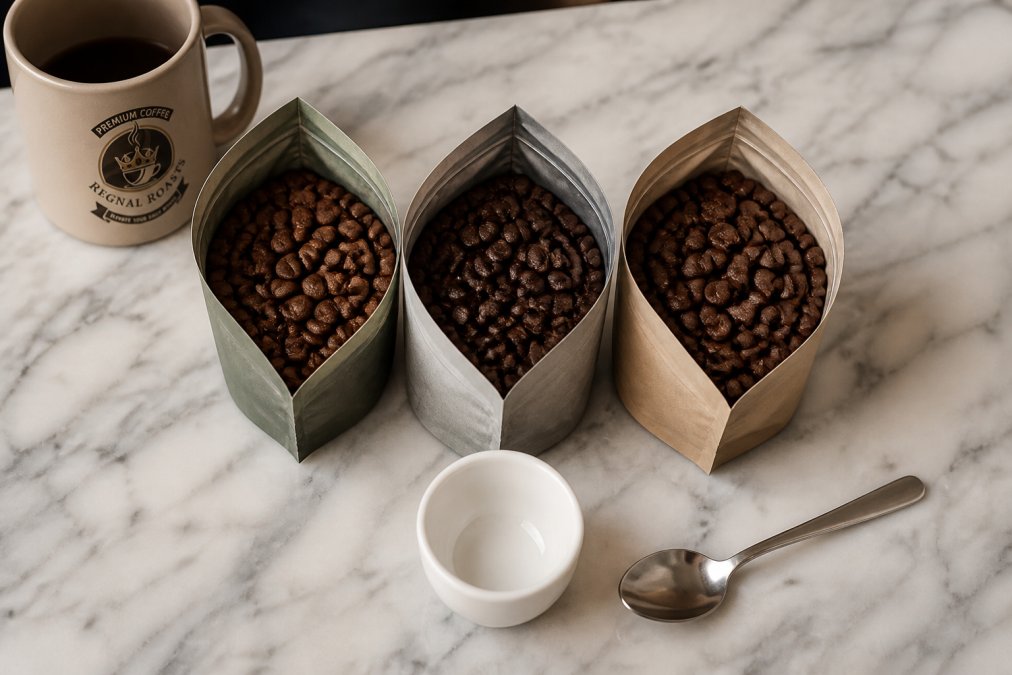
The best coffee sampler packs pair a printed roast date with enough variety to learn your preferences. Here are the formats worth your attention this year.
Best Sellers Sample Pack
If you only try one, make it this one. The Best Sellers Sample Pack ($23.23) gives you six 2-ounce coffees spanning bold blends and rare single origins: the 6 Bean dark roast, Cowboy Blend, Breakfast Blend, plus Peru, Mexico, and Bali single origins. It covers both ends of the roast spectrum in one order.

A good starter sampler should include at least one coffee you'd never pick yourself, and this pack does. The Peru brings salted caramel and citrus; the Bali leans dark chocolate and molasses.
Flavored Coffees Sample Pack
For daily flavored coffee drinkers, the Flavored Coffees Sample Pack ($23.23) is the efficient move. Six 2-ounce bags cover French Vanilla, Hazelnut, Cinnabun, Caramel, Mocha, and Cinnamon Hazelnut, each built on a specialty-grade single origin base and flavored with natural oils.


Single Origin Favorites Sample Pack
Coffee enthusiasts who want to taste terroir should start here. The Single Origin Favorites Sample Pack ($23.23) includes six origins: Brazil Santos, Colombia, Costa Rica, Ethiopia, Honduras, and Tanzania, each roasted to suit its character.
Individual Flavored Bags: Candy Cane, French Vanilla, Hazelnut, and More
Once you know your favorite, buy it in a full bag. Candy Cane ($17.65) delivers cool peppermint sweetness year-round. French Vanilla ($17.65) is the silky, well-rounded medium roast that pairs with almost anything. Hazelnut starts from a Brazilian single origin for toasted depth. Mexican Chocolate ($17.65) layers dark chocolate, cinnamon, and vanilla. Chocolate Hazelnut ($23.23) and Cinnabun round out the indulgent end.
How to Evaluate Coffee Roast Profiles Before You Buy
Roast level tells you more about what's in the cup than origin alone. Light roasts keep more natural acidity and origin character, medium roasts balance sweetness and body, and dark roasts push toward cocoa, caramel, and smoke. But reading a roast profile is only half the job; the other half is knowing how to taste what you bought.
Here's a practical framework for reading a roast profile before you order:
- Light roast: bright acidity, fruity and floral notes, thinner body
- Medium roast: balanced sweetness, caramel and nut tones, medium body
- Dark roast: low acidity, cocoa and molasses, full body
- Medium-light: the sweet spot for single origins where you want origin character plus drinkability
Tasting notes like "dried orange" or "brown sugar" describe the flavor profile you should expect, not added ingredients. Reading them against the roast level tells you whether the coffee will taste bright or rich.
A Beginner's Flavor Wheel: Acidity, Body, Sweetness
Most sampler buyers can't name what they're tasting, so they default to "smooth" or "strong." A flavor wheel fixes that by breaking every cup into three measurable axes. You don't need a certification, just a consistent routine.
- Acidity is the bright, juicy sensation on the sides of your tongue, not sourness. A washed Ethiopia reads high-acid (citrus, berry); a Sumatra reads low-acid (earthy, syrupy).
- Body is the weight or texture, how the coffee coats your mouth. French press tends to amplify body; a paper-filter pour over mutes it.
- Sweetness is the finish that lingers after you swallow. Caramel, brown sugar, and honey are the common markers, and they show up strongest in medium and medium-light roasts.
Reading Tasting Notes Without Getting Fooled
Tasting notes are a roaster's best guess at what a trained palate will find, not a guarantee. Two rules keep you from over-trusting them:
- Match the note to the roast level. "Strawberry" on a dark roast is almost always a flavored or processed coffee, not a natural fruit note. "Strawberry" on a light-roast Ethiopia is plausible.
- Trust your second cup, not your first. The first cup of any new coffee is unreliable because your palate is still calibrated to whatever you drank yesterday. By cup two or three, you'll know whether the note is real for you.
The Specialty Coffee Association's flavor resources offer a useful reference for matching tasting notes to what you actually taste, and their flavor wheel is the same one used in professional cupping.
How to Store Fresh Coffee Beans After Your Sampler Arrives
Storing fresh coffee beans correctly means protecting them from four enemies: oxygen, light, heat, and moisture. Control those and your sampler stays good for weeks.
The practical routine:
- Keep beans in an opaque, airtight container at room temperature
- Skip the fridge, and never freeze and refreeze the same beans
- Keep bags sealed and squeeze out excess air between uses
- Use smaller samples first so nothing sits open too long
With a sampler, keep each 2-ounce portion sealed until you brew it, so you taste each coffee at its peak.
Best Coffee Subscription Boxes for Connoisseurs
The best coffee subscription boxes for connoisseurs deliver rotating roasts on a schedule, so you're always drinking something fresh without reordering manually. The real question is whether a subscription saves money compared to buying samplers until you find a daily driver. Here's the math.
Subscription vs. One-Time Sampler: The ROI Breakdown
Run the numbers on your own drinking habits before committing to either:
- Count your cups per week. A typical home brewer drinks one to two cups a day, so roughly 7 to 14 cups a week.
- Convert to ounces of roasted coffee. At a standard 1:16 water-to-coffee ratio, a 12-ounce mug uses about 0.75 ounces of coffee. That's roughly 5 to 11 ounces of beans per week.
- Compare the two paths. A 2-ounce sample yields two to three cups. A 12-ounce bag yields roughly 16 cups. If you drink 10 cups a week, a single 12-ounce bag lasts about a week and a half.
The trade-off isn't price per bag, it's price per cup plus the cost of being wrong. A sampler costing about the same as one full bag spreads your risk across six coffees. A subscription locks in a recurring cost but usually lowers per-bag pricing through volume or member rates. Neither is cheaper in the abstract, the cheaper option matches how fast you actually drink.
When a Subscription Wins
- You finish a 12-ounce bag in two weeks or less and hate running out.
- You want variety without thinking about reordering.
- You're willing to drink a roast you didn't choose in exchange for never drinking stale coffee.
When One-Time Samplers Win
- You drink slowly and a full bag goes stale before you finish it.
- You already know your two or three favorites and just want to reorder those.
- You're still building your palate and want to control the sequence.
The Hybrid Path Most Connoisseurs Land On
A common pattern: run two or three sampler rounds first, identify two or three coffees you'd reorder, then subscribe only to a roaster whose rotation you've vetted. That avoids paying for a subscription during the discovery phase, and every recurring shipment is a coffee you know you'll finish.
If you go the subscription route, check three things before committing: whether you can pause or skip a shipment, whether the roaster prints a roast date (not just a best-by date), and whether the rotation includes origins you already like. A subscription shipping six months of light-roast Ethiopians when you drink dark blends is one you'll cancel in month two.
For guidance on freshness and storage standards, the FDA information on food storage and safety is a helpful reference point for how perishable goods should be handled.
Conclusion
The hardest part of buying coffee online is committing to a full bag you've never tasted. Sampler packs solve that by letting you test six coffees for the price of one and teaching you which roast levels and origins you genuinely enjoy.
At Regnal Roasts, we built our sampler lineup around exactly that idea. Our handcrafted blends are small-batch roasted, and our sample packs let you explore the full range before committing. Every flavor starts from specialty-grade beans, and our K-Cup compatible pods bring the same roasts to single-serve machines without compromise.
Start with a sampler, find the roast that reigns over your mornings, and subscribe to our emails for new releases and brewing guidance.
Frequently Asked Questions
What is the best way to sample different premium coffees?
Start with a curated multi-bag sampler that spans roast levels and origins. The Best Sellers Sample Pack from Regnal Roasts gives you six 2oz bags for $23.23, covering dark blends, medium blends, and single origins from Peru, Mexico, and Bali. Brew each one the same way, using the same water-to-coffee ratio, so you can compare tasting notes fairly. Take brief notes on aroma, acidity, body, and aftertaste. Once you find a favorite, order a full-size bag.
Are coffee sampler packs worth the money?
Yes, when you treat them as a low-risk test before buying a full bag. A $23.23 sampler like the Flavored Coffees Sample Pack lets you try six flavors, including French Vanilla, Hazelnut, Cinnabun, Caramel, Mocha, and Cinnamon Hazelnut, without committing to a 12oz bag of each. That is roughly $3.87 per 2oz sample. If even one becomes a repeat purchase, you have avoided wasting money on a full bag you did not enjoy.
How do I choose a coffee sampler based on my flavor preferences?
Match the sampler to the flavors you already enjoy. If you like bold, chocolatey cups, look for dark and medium blends such as the Best Sellers Sample Pack. If you prefer sweet, dessert-style coffee, the Flavored Coffees Sample Pack covers vanilla, hazelnut, and cinnamon profiles. If you want to explore regional differences, the Single Origin Favorites Sample Pack walks you through Brazil, Colombia, Costa Rica, Ethiopia, Honduras, and Tanzania, each with distinct tasting notes.
How long do coffee beans stay fresh in sampler packs?
The 2oz bags in a Regnal Roasts sampler are sized to finish quickly, so freshness is rarely an issue if you brew daily. Once you open a bag, transfer the coffee to an airtight container and keep it in a cool, dark cabinet away from the stove. Avoid the freezer for daily-use coffee, since repeated thawing introduces moisture that dulls aroma and flavor.
Do premium coffee samplers make good gifts?
They are one of the safest coffee gifts because they let the recipient find their own favorite instead of receiving a full bag they may not like. A six-bag sampler at $23.23 feels generous without being extravagant, and the variety makes it work for almost any taste, from dark roast drinkers to flavored coffee fans. Pair it with a mug or a small pour-over dripper for a complete gift set.