

Pour Over vs Pod Coffee for Rituals
Table of Contents
- The Ritual: Why Brewing Method Matters Beyond the Cup
- Brewing Process and Extraction: Manual Control vs Automated Convenience
- Coffee Brewing Time Comparison: Morning Rhythm and Workflow
- Flavor Profile, Clarity, and Tasting Notes
- The Mindful Morning Coffee Routine: Ritual as Self-Care
- Essential Pour Over Coffee Accessories and Equipment Requirements
- Cost Per Cup and Long-Term Investment
- Environmental Impact and Sustainability Lifecycle
- Frequently Asked Questions
Last Updated: October 3, 2026
The Ritual: Why Brewing Method Matters Beyond the Cup
When you reach for your morning coffee, you're not just chasing caffeine. You're choosing between two fundamentally different experiences: the meditative flow of pour over vs pod coffee for rituals, or the instant gratification of a single-serve pod. At Regnal Roasts, we understand this choice reshapes how people approach their daily ritual, and the difference goes far deeper than convenience.

The question isn't really which brewing method is "better." It's which aligns with how you want to spend your morning. Pour over demands your presence. It asks you to control water temperature, grind size, bloom time, and flow rate. Pod brewing hands that control to a machine. Both deliver excellent coffee. Both can anchor a meaningful ritual. But they create entirely different experiences, and understanding those differences helps you choose what actually fits your life.
Here's what we'll explore: the mechanics of extraction in each method, how they reshape your morning timeline, the flavor profiles they produce, and the real costs and environmental trade-offs. By the end, you'll know which brewing approach serves your ritual best.
Brewing Process and Extraction: Manual Control vs Automated Convenience
How pour-over extraction works
Pour over is an immersion and percolation hybrid. Hot water passes through coffee grounds and a paper or metal filter, extracting flavor compounds as it flows downward into your cup. You control nearly every variable: water temperature (ideally 195-205°F), grind size, pour rate, and bloom time (the initial 30-45 seconds when water saturates the grounds before full brewing begins).
This precision is the method's defining feature. A finer grind slows water flow and increases extraction time. A coarser grind speeds it up. Pouring in circular motions versus pulsing water creates different extraction patterns. The bloom phase allows CO2 to escape from freshly roasted beans, which improves flavor clarity and prevents channeling (water finding weak paths through the grounds).
The result is a cup with pronounced tasting notes. You taste the nuance. The acidity, body, and subtle flavor notes stand out because the manual process lets you optimize for the specific beans you're brewing. Single-origin coffees especially benefit from this precision, a Peruvian single-origin with salted caramel notes or a Mexican coffee with lemon and brown sugar comes alive when you control the extraction.
How pod brewing extracts flavor
Pod brewing is fully automated extraction. Water heats to a preset temperature, punctures the pod, and forces hot water through grounds under pressure. Most single-serve brewers use a percolation model similar to pour over, but without your input. The machine decides water temperature, pressure, and flow rate.
Regnal Roasts K-Cup compatible pods are engineered to work within this automated system. Each pod contains a precision-engineered filter designed to maximize extraction without slowing your brew. The nitrogen-sealed freshness in our pods, each capsule is oxygen-free, locks in peak flavor from roast to brew, compensating for the lack of manual control.
Pod brewing trades precision for consistency. You get the same cup every time because the machine removes variables. For busy mornings, this is a feature, not a limitation. You don't have to think about grind size or water temperature. You press a button and receive a bold, balanced cup in under two minutes.
Coffee Brewing Time Comparison: Morning Rhythm and Workflow
Pour over takes 3-4 minutes from start to finish. That includes heating water, blooming the grounds, and the full brew cycle. For remote workers building a morning ritual, this timeline becomes part of the experience. You're not multitasking. You're present with the coffee, watching the water darken as it flows through, listening to the pour, noticing the aroma intensify.
This isn't wasted time. Many people find that the tactile, deliberate process of pour over grounds their morning before work begins. The workflow becomes meditative. Your hands are occupied. Your attention narrows. Neuroscientists call this "flow state", the mental state where focus and action merge.
Pod brewing takes 60-90 seconds. You insert a pod, press a button, and your coffee is ready while you check messages or start your commute. For empty-nesters and established professionals who value efficiency, this speed is essential. It fits into a packed morning.
The choice here isn't about which is "faster" in absolute terms. It's about whether you want your morning coffee to be the focus or the backdrop.
Flavor Profile, Clarity, and Tasting Notes
Pour over excels at flavor clarity. Because you control extraction, you can dial in the exact moment when the cup reaches peak taste, not over-extracted (bitter, harsh) or under-extracted (sour, thin). This is especially true for specialty coffees with distinct tasting notes.
Take a single-origin Mexican coffee sourced from the highlands of Chiapas. When brewed as pour over, you detect lemon brightness, brown sugar sweetness, and dark chocolate body distinctly. Each flavor note sits separately in your palate. The acidity feels clean. The finish is crisp.
Pod brewing produces a different flavor experience. The automated extraction is optimized for balance and consistency, not complexity. You get a bold, rounded cup. The flavor notes blend together rather than standing apart.
This is where Regnal Roasts K-Cup compatible pods shine for people who refuse to compromise on taste. Our precision-engineered filter and nitrogen-sealed freshness push pod brewing toward the flavor clarity that usually requires manual control. You get specialty coffee quality, single-origin beans, and distinct tasting profiles, without the ritual time investment.
The Mindful Morning Coffee Routine: Ritual as Self-Care
The psychological benefit of pour over extends beyond taste. Rituals anchor us. They create boundaries between sleep and work, between chaos and intention. A pour over routine signals to your brain that this moment is yours before the day claims it.
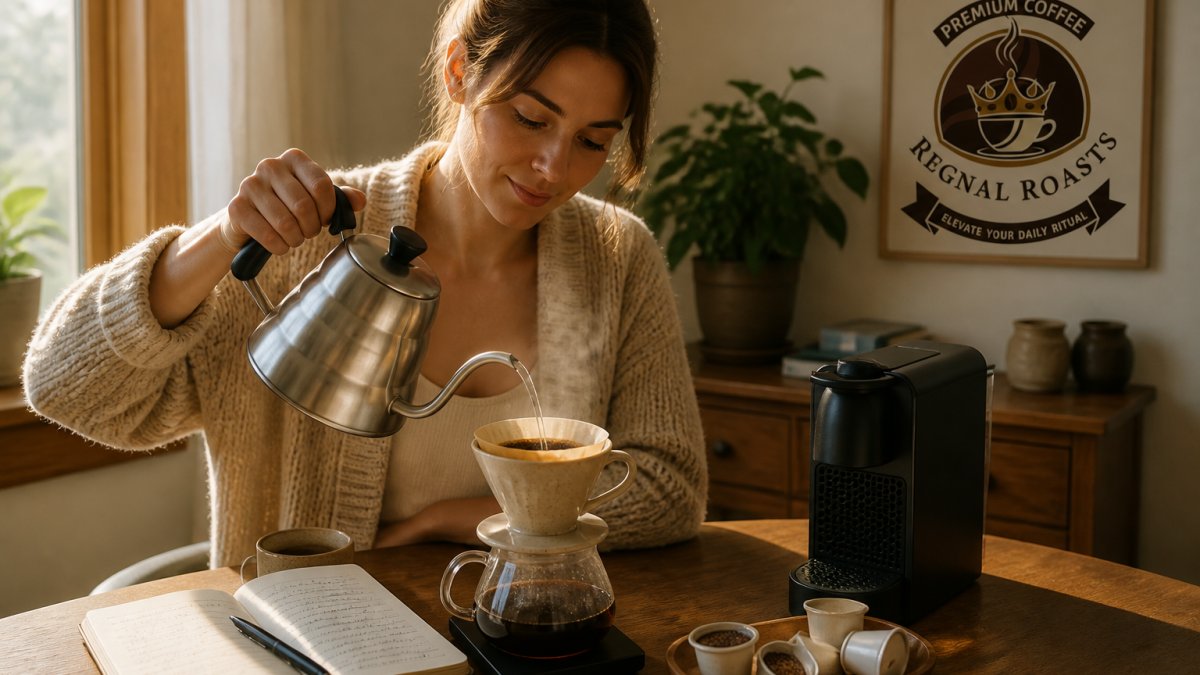
The tactile elements matter. Holding a gooseneck kettle. Feeling the heat. Watching water bloom the grounds and release aroma. These sensory details activate different neural pathways than pressing a button. You're not just consuming coffee, you're performing a ceremony.
Pod brewing offers a different kind of ritual: the ritual of reliability. You know exactly what you're getting. The consistency itself becomes comforting. For remote workers who've eliminated commutes and office routines, a single-serve pod might be the only moment each morning that feels structured and familiar.
The choice between these rituals depends on what your morning needs. Are you seeking slowness and presence? Pour over. Are you seeking comfort through consistency and efficiency? Pod brewing. Both are valid approaches to self-care through coffee.
Essential Pour Over Coffee Accessories and Equipment Requirements
Pour over requires more equipment than pod brewing, but the footprint is smaller than you might expect.
You need a dripper (ceramic, glass, or metal, each affects flavor slightly), paper or metal filters, a gooseneck kettle for precise pouring, a scale to measure coffee and water by weight (this is where precision happens), and a grinder. The grinder is non-negotiable. Pre-ground coffee oxidizes quickly and loses flavor clarity.
A basic setup costs under $100. A refined setup with a quality burr grinder and temperature-controlled kettle runs $200-300. The equipment itself becomes part of the ritual. You're investing in tools that demand skill and attention. Many people find that investment meaningful, it signals that coffee time matters.
Maintenance is straightforward. Rinse your dripper and filters after each use. Clean your grinder monthly. Descale your kettle occasionally. The workflow becomes familiar, another small ritual within the larger ritual.
Pod brewing requires a single-serve brewer. The upfront cost is similar ($80-200 for quality machines), but maintenance is minimal. You insert a pod, brew, and discard. No grinding, no filters, no cleanup beyond rinsing the cup.
Cost Per Cup and Long-Term Investment
This is where the math becomes interesting. A pour over setup with a quality grinder costs $200-300 upfront. Coffee beans run roughly $12-16 per pound. A pound yields about 16 cups (assuming 0.5 ounces per cup). That's $0.75-$1.00 per cup for beans alone, plus negligible costs for filters and water.
Pod brewing requires a brewer ($80-200) and pods. Regnal Roasts K-Cup compatible pods start at $17.65 for a 12-pack, which equals $1.47 per pod. A 60-pack costs $55.77, bringing the per-pod cost down to $0.93. For single-origin specialty pods like our Mexican or Peruvian varieties, the cost per cup remains competitive with pour over while eliminating the time and skill requirement.

The real cost difference emerges over time. If you brew daily, a pour over setup pays for itself within months. If you value your time at $30+ per hour, the 3-4 minutes daily adds up. For someone brewing 300 cups annually, that's 1,000-1,200 minutes, roughly 17-20 hours per year. Whether that time feels like an investment or a cost depends entirely on whether you want that ritual.
Environmental Impact and Sustainability Lifecycle
Pour over's environmental footprint depends on your filter choice. Paper filters are compostable but require trees and bleaching. Metal filters are reusable and eliminate waste. Neither requires electricity beyond heating water.
Pod brewing generates plastic waste. Even K-Cup compatible pods, despite their convenience, create a disposal problem. Each pod is single-use.
This is a legitimate concern, and we acknowledge it directly. At Regnal Roasts, we've designed our K-Cup compatible pods with nitrogen-sealed freshness to extend shelf life and reduce the temptation to over-purchase.
However, sustainability isn't purely about waste. It's also about resource use. Pour over requires a grinder, which uses electricity. It requires beans, which demand agricultural land, water, and transportation.
| Brewing Method | Setup Cost | Cost Per Cup | Time Per Brew | Equipment Footprint | Waste Type |
|---|---|---|---|---|---|
| Pour Over | $200-300 | $0.75-$1.00 | 3-4 minutes | Small (dripper, kettle, grinder) | Compostable filters or reusable metal |
| Pod Brewing | $80-200 | $0.93-$1.47 | 60-90 seconds | Compact (single brewer) | Plastic pods per brew |
The choice between pour over vs pod coffee for rituals isn't about finding the objectively superior method. It's about matching your brewing approach to how you want your mornings to feel.
For those who crave the ritual and have the time, pour over is unmatched.
Subscribe to our emails for brewing tips, new roast releases, and insights into how to elevate your daily coffee ritual, regardless of which method you choose.
Frequently Asked Questions
What are the primary differences between pour-over and pod coffee rituals?
Pour-over coffee requires manual water pouring, grind size control, and active participation in the brewing process, typically taking 3-5 minutes. Pod coffee automates extraction through pre-measured, sealed capsules compatible with single-serve brewers, completing in under 2 minutes. Pour-over emphasizes precision, tactile engagement, and nuanced flavor extraction. Pods prioritize consistency and convenience. The choice depends on whether you value the ritualistic, meditative aspects of manual brewing or prefer streamlined automation in your morning routine.
Is pour-over coffee considered healthier than pod-based coffee?
Both methods produce nutritionally similar coffee. The key difference lies in filtering: pour-over with paper filters removes more oils and sediment, potentially reducing cholesterol compounds in the final cup. Pod systems use micro-filters that retain slightly more coffee oils. Neither approach is inherently healthier; the choice depends on personal preference for body and mouthfeel. What matters most is coffee quality and freshness, both pour-over and premium K-Cup compatible pods can deliver excellent results when sourced from quality roasters like Regnal Roasts.
What equipment is needed to start a pour-over coffee ritual?
Essential pour over coffee accessories include a dripper (ceramic, glass, or plastic cone), filter paper or reusable metal filters, a gooseneck kettle for precise water pouring, a kitchen scale for accurate brew ratios, and freshly roasted whole beans with a grinder. Optional but valuable additions include a burr grinder for consistent grind size and a thermometer to monitor water temperature between 195-205°F. Pod brewing requires only a compatible single-serve brewer and K-Cup compatible capsules, making it significantly more accessible for those seeking simplicity.
How does the time investment of a pour-over ritual impact daily mindfulness?
Pour-over brewing creates a deliberate pause in your morning, typically 3-5 minutes of focused attention on water temperature, bloom phase, and pour rate. This tactile, sensory-engaged process activates mindfulness naturally, you're present with the aroma, sound of water, and visual progression of extraction. Many coffee enthusiasts describe this as meditative self-care that sets a calmer tone for the workday. Pod coffee offers speed but eliminates this ritualistic element. For remote workers and those prioritizing a mindful morning coffee routine, pour-over's built-in slowness becomes a feature, not a drawback.
What's the actual cost per cup comparing pour-over and pod coffee?
Regnal Roasts K-Cup compatible pods start at $17.65 for a 12-pack, which equals $1.47 per pod. A 60-pack costs $55.77, bringing the per-pod cost down to $0.93. Pour-over costs $0.75-$1.00 per cup for beans alone, though initial equipment investment (dripper, kettle, grinder) runs $200-$300. Pods offer better value for occasional drinkers; pour-over becomes economical for daily ritualists who appreciate equipment investment as part of the lifestyle.