

Highest Quality K Cup Coffee: What to Look For
Table of Contents
- What Makes the Highest Quality K Cup Coffee?
- How to Choose Premium Coffee Pods: A Selection Framework
- Best Gourmet K-Cups: Tasting Notes and What Sets Them Apart
- Reusable K-Cup Filters: What They Change About Quality
- Water Quality and Machine Maintenance: The Overlooked Half of Flavor
- Cost Per Cup: What Premium Pods Actually Run You
- Conclusion
- Frequently Asked Questions
Last Updated: September 25, 2026
What Makes the Highest Quality K Cup Coffee?
The highest quality K cup coffee starts with two things most pod buyers never check: a roast date printed on the box, and a nitrogen-sealed capsule that keeps oxygen away from the grounds. At Regnal Roasts, we build every pod around those two principles. This guide explains how to spot a fresh pod, match a roast profile to your taste, and what a premium capsule costs per cup.
Roast Date, Not Expiration Date
A roast date tells you when the beans left the roaster; an expiration date tells you when the manufacturer stops guaranteeing the product. Very different promises.
Single-Origin vs. Blend in Pods
Single-origin coffee comes from one growing region and shows that region's character: a Kenyan lot tastes bright and citrusy, a Sumatran lot earthy and full-bodied. A blend combines origins for a consistent, balanced cup.
How to Choose Premium Coffee Pods: A Selection Framework
Choosing premium coffee pods comes down to four checks: roast date, origin transparency, packaging seal, and roast level. Run every box through them before you buy:
- Find the roast date. If the box only shows an expiration date, treat freshness as unknown.
- Check the seal. Nitrogen-flushed or oxygen-free capsules protect flavor far better than loose foil.
- Read the origin. A named region, altitude, and process signal a roaster who cares. Vague "gourmet blend" language signals the opposite.
- Match the roast level. Light roasts run acidic and fruity. Medium roasts balance sweetness and body. Dark roasts lean bitter and smoky.
- Confirm compatibility. Most capsules work with standard K-Cup brewers, but check before ordering in bulk.
| Check | What Good Looks Like | Why It Matters |
|---|---|---|
| Roast date | Printed date within weeks | Freshness drives aroma |
| Packaging | Nitrogen-sealed, oxygen-free | Slows oxidization |
| Origin | Named region and process | Signals real sourcing |
| Roast level | Matches your taste | Controls acidity and body |
| Filter design | Engineered for extraction | Prevents weak or bitter cups |
Best Gourmet K-Cups: Tasting Notes and What Sets Them Apart
The best gourmet K-cups separate themselves through traceable sourcing, a clean roast profile, and capsules built for even extraction. But "best" depends on the roast level and origin character you want, use the framework below to match a pod to your palate.
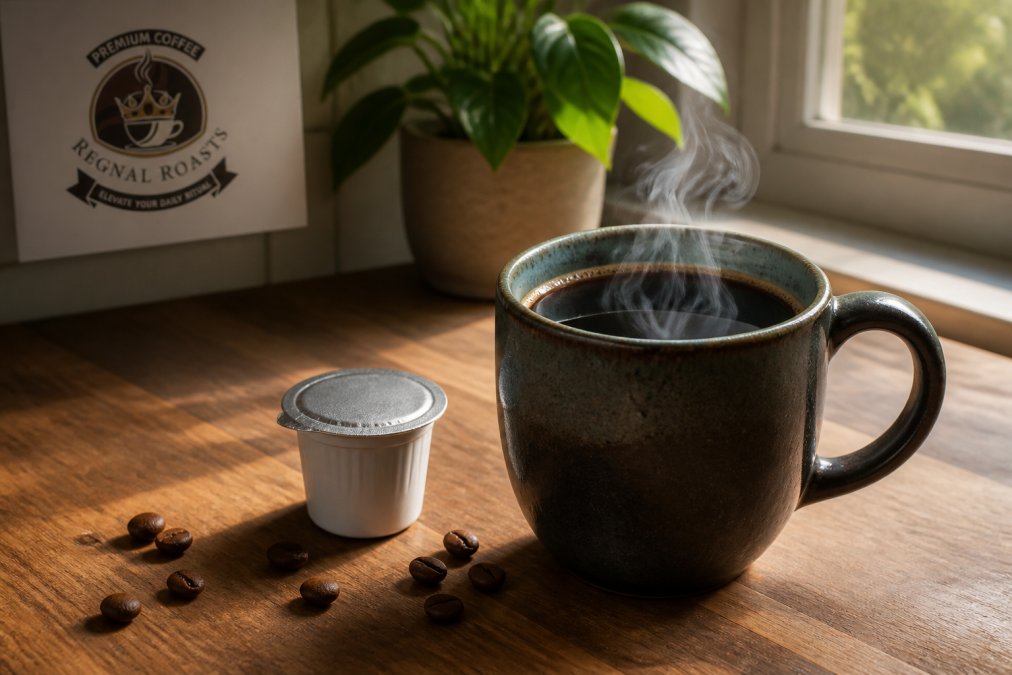
How to Read a Gourmet Pod Before You Brew It
Four attributes predict what a pod will taste like:
- Roast level controls how much acidity and origin character survive. Light roasts keep fruit and florals; dark roasts trade them for caramelized, smoky notes.
- Origin sets the baseline flavor family. East African coffees tend toward citrus and florals; Indonesian toward earthy, syrupy body; Latin American toward chocolate, caramel, and nut.
- Process shapes texture and sweetness. Washed coffees taste clean and structured; natural and wet-hulled coffees taste heavier and fruitier.
- Altitude correlates with density and sweetness. Higher-grown beans ripen slower, building the sugars and acids that read as "lively" in the cup.
Hold those four against any box and you can predict the cup before buying a 60-pack.
Bright and Citrus-Forward Options
If you like acidity and lift, reach for high-grown beans. The Kenya single origin, grown at 1,700-1,890 meters in Nyeri County, delivers bright orange and lemon notes with a floral, effervescent finish. The Mexican K-Cup Compatible pods, from the highlands of Chiapas, balance lemon and brown sugar with a creamy body and medium acidity.

Rich and Chocolatey Options
For deeper, heavier cups, look to lower-acid origins. The Bali Coffee K-Cup Compatible Pods bring dark chocolate, molasses, and brown sugar in a medium-dark roast that stands up to cream. The Sumatra Single Origin leans earthy, with dried fruit and a long, syrupy body from its wet-hulled process.
Matching Roast Level to How You Drink It
Roast level is the biggest lever most buyers ignore. A common pattern among daily pod drinkers:
| How You Drink It | Roast Level That Works Best | Why |
|---|---|---|
| Black, no sugar | Light to medium | Preserves origin acidity and aroma |
| With milk or cream | Medium to medium-dark | Body and caramel notes survive dilution |
| With sweetener only | Medium | Balances sweetness without going flat |
| Iced or cold brew style | Medium-dark to dark | Holds flavor when chilled |
| Flavored pods | Medium or dark base | Base roast carries added flavoring |
What Separates a Gourmet Pod From a Commodity Pod
Beyond flavor, three structural details separate gourmet pods from commodity capsules:
- Grind consistency. Even particle size means even extraction. A pod ground for a drip basket under-extracts in a pressure brewer; too fine a grind chokes flow and tastes bitter.
- Dose weight. A consistent gram dose per capsule makes a pod repeatable cup to cup. Underfilled pods taste weak no matter how good the bean is.
- Capsule seal. Nitrogen-flushed, oxygen-barrier capsules protect the grounds from the moment they are filled. Foil-only or loosely sealed pods lose aroma within weeks.
A Quick Comparison Across the Lineup
| Pod | Roast Level | Dominant Notes | Body | Best For |
|---|---|---|---|---|
| Kenya | Light-medium | Orange, lemon, floral | Medium | Black coffee drinkers |
| Mexico | Medium | Lemon, brown sugar, cream | Medium | Balanced everyday cup |
| Peru | Medium | Salted caramel, citrus | Silky | Milk and cream |
| Colombia | Medium | Chocolate, red fruit | Medium | All-purpose |
| Guatemala | Medium | Cocoa, stone fruit | Medium | Pour-over converts |
| Bali | Medium-dark | Dark chocolate, molasses | Full | Cream and sugar |
| Sumatra | Dark | Earthy, dried fruit | Syrupy | Bold, low-acid drinkers |
Use the table as a starting map, not a verdict. The same origin can taste different across roasters depending on roast development and grind, which is why the roast date and seal checks above matter as much as the label.
Reusable K-Cup Filters: What They Change About Quality
Reusable K-cup filters change two variables: grind control and cost. You fill them with your own coffee, so you choose the roast date, grind, and dose.
Water Quality and Machine Maintenance: The Overlooked Half of Flavor
Water quality and machine maintenance affect flavor as much as the coffee itself. Most pod reviews ignore both, yet they explain a huge share of "why does my coffee taste off" complaints.
Why Water Is the Largest Ingredient in Your Cup
A brewed cup is roughly 98 to 99 percent water by weight, so the minerals dissolved in your water do real chemical work during extraction. Two variables matter most:
- Total dissolved solids (TDS). Water that is too mineral-heavy mutes acidity and aroma, and can taste chalky. Water that is too soft under-extracts and produces a flat, hollow cup. A common target among coffee professionals is roughly 75 to 125 ppm TDS for brewing.
- Alkalinity and hardness. High alkalinity buffers the acids that give coffee its brightness, which is why the same pod can taste dull on one tap and vivid on another. Hardness above roughly 150 ppm accelerates scale buildup inside the brewer.
How Scale Quietly Ruins Pod Quality
Mineral scale is calcium and magnesium carbonate that precipitates out of hard water and deposits on hot metal surfaces, inside a pod brewer, the heating element, brew head, and exit needle.
As scale builds:
- Flow slows. Restricted flow stretches brew time, over-extracting the grounds and pushing the cup toward bitterness.
- Brew temperature drops. Scale insulates the heating element, so water arrives cooler than intended and under-extracts.
- The exit needle clogs. Grounds and scale partially block the puncture point, producing weak, uneven cups and occasional blowouts.
A Maintenance Routine That Protects Flavor
A short, consistent routine covers most of it:
- Rinse the brew head and needle weekly. Pull the pod holder, rinse it under warm water, and wipe the puncture needle with a damp cloth. Grounds left in the needle are the fastest route to a sour or stale-tasting cup.
- Run a plain water cycle weekly. A brew cycle with no pod flushes loose grounds and residual oils out of the internal path.
- Descale on the schedule your brewer's manual recommends. For most home pod brewers, that is roughly every three months with average water, and closer to every four to eight weeks if your water is hard. Use a descaling solution or citric-acid-based descaler formulated for coffee brewers, then run two or three plain water cycles to flush residue.
- Replace the water filter cartridge as directed. A spent inline filter stops filtering and can start contributing off-flavors.
A Simple Diagnostic Order
When a cup tastes wrong, run this sequence before buying new pods:
- Taste the water. Flat or metallic water will flatten the coffee.
- Check the pod's roast date. If it is more than a few months old, freshness is the likely culprit.
- Look at the needle and gasket. Visible grounds or scale means the brewer needs a rinse.
- Time a brew cycle. A noticeably slow cycle points to scale.
- Descale, then re-brew the same pod. If flavor returns, the machine was the problem, not the coffee.
Cost Per Cup: What Premium Pods Actually Run You
Premium pods cost more per cup than commodity capsules, but the gap narrows against café prices. At Regnal Roasts, the 12 Pack Single Serve K-Cup Compatible runs $17.65, and the 60 Pack Single K-Cup Compatible runs $55.77.

| Option | Price | Capsules | Cost Per Cup | Best For |
|---|---|---|---|---|
| 12 Pack Single Serve | $17.65 | 12 | About $1.47 | First-time buyers |
| 60 Pack Single Serve | $55.77 | 60 | About $0.93 | Daily drinkers |
| Single-origin pods | $17.65 | 12 | About $1.47 | Exploring regions |
Conclusion
The question of what the highest quality K cup coffee is has a practical answer: fresh roast date, honest origin, sealed packaging, and a brewer you actually maintain. Nail those four, and the cup takes care of itself.
Frequently Asked Questions
Which K-cup coffee is best according to consumer reports?
Consumer testing consistently rewards pods with recent roast dates, single-origin sourcing, and nitrogen-sealed packaging. The highest quality K Cup coffee tends to come from roasters who print a roast date rather than a distant expiration date, because oxygen is what flattens flavor over time. Look for pods where the coffee is traceable to a specific region, like the Chiapas highlands or the Andes, and where the roast profile matches your taste: medium for balance, medium-dark for depth.
What is the best K-cup coffee that is not bitter?
Bitterness in single-serve coffee usually comes from over-extraction, stale grounds, or a dark roast pushed too far. A medium roast with a washed process, such as a Peruvian single origin with salted caramel and citrus notes, brews sweet and clean without the harsh edge. Check your brewer's water temperature too.
Does roast level affect the quality of K-cup coffee?
Roast level shapes flavor more than it shapes quality. Light roasts keep more acidity and origin character, medium roasts balance sweetness and body, and dark roasts push toward smoke and bittersweet chocolate. A well-made dark roast is not lower quality than a light one, but dark roasting can mask defects in cheap beans. For single-serve pods, medium and medium-dark roasts tend to hold up best because the brewing cycle is short and fixed.
Can reusable K-cup filters improve coffee quality?
Reusable K-cup filters let you control grind consistency and dose, which are the two biggest variables in pod brewing. A burr grinder set to a medium-fine grind, paired with freshly roasted beans, will outperform most pre-filled pods. The trade-off is cleanup and the risk of under-extraction if your grind is too coarse. If convenience matters more, nitrogen-sealed pods with a precision-engineered filter are the better path.
How much should I expect to pay per cup for premium K-cup coffee?
Cost per cup depends on pack size. A 12-pack of single-serve pods at $17.65 works out to roughly $1.47 per cup, while a 60-pack at $55.77 drops that to about $0.93 per cup. For comparison, a daily coffee shop habit at $4 to $5 per cup runs $1,460 to $1,825 a year. Premium pods land well below that while still delivering single-origin flavor and nitrogen-sealed freshness.