

Fresh Roasted Coffee Beans: A 2026 Comparison Guide
Table of Contents
- Why Fresh Roasted Coffee Beans Taste Different
- The Coffee Roast Date Importance Nobody Talks About
- Regnal Roasts Single-Origin Lineup Compared
- How to Tell If Coffee Beans Are Fresh
- How to Store Coffee Beans for Freshness
- Sustainability and Ethical Sourcing in Fresh Roasted Coffee
- Which Fresh Roasted Coffee Beans Should You Choose?
- Frequently Asked Questions
Last Updated: September 19, 2026
Why Fresh Roasted Coffee Beans Taste Different
Fresh roasted coffee beans taste different because the roast date, not the label, decides what lands in your cup. Coffee begins losing aromatic compounds the moment it leaves the roaster, and the gap between a two-week-old bag and a two-month-old bag is wider than most drinkers expect.
The Coffee Roast Date Importance Nobody Talks About
Roast date importance comes down to one fact: whole bean coffee has a shelf life measured in weeks, not months. Once beans are exposed to oxygen, the oils that carry flavor begin to oxidize, and no packaging trick reverses that clock.
What Degassing Does to Flavor in the First Two Weeks
Degassing is the release of carbon dioxide trapped inside a bean during roasting. During the roast, heat drives off moisture and triggers the Maillard reaction and caramelization, and those reactions generate CO2 that stays pressurized inside the bean's cell structure. After the roast, that gas escapes slowly through the bean's pores.
Why Rest Time Depends on Your Brew Method
There is no single "best" rest window, because each brew method tolerates CO2 differently.
- Espresso (3 to 10 days post-roast): Pressurized extraction amplifies CO2 problems. Beans rested less than about three days tend to produce gushing shots, thin crema, and sour notes because the gas disrupts the puck. Most espresso-focused roasters suggest a rest of 5 to 10 days.
- Pour-over and drip (4 to 14 days): Gravity and paper filters are more forgiving. A 4-to-7-day rest usually gives a clean bloom and even extraction; waiting past 10 days starts trading brightness for oxidation.
- French press and cold brew (7 to 21 days): Long immersion and coarse grind mean CO2 has more time to escape before it interferes. These methods tolerate, and sometimes benefit from, a longer rest.
- AeroPress and moka pot (5 to 12 days): Middle ground. Enough pressure to be sensitive to gas, but short enough contact time that a week of rest is usually sufficient.
Regnal Roasts Single-Origin Lineup Compared
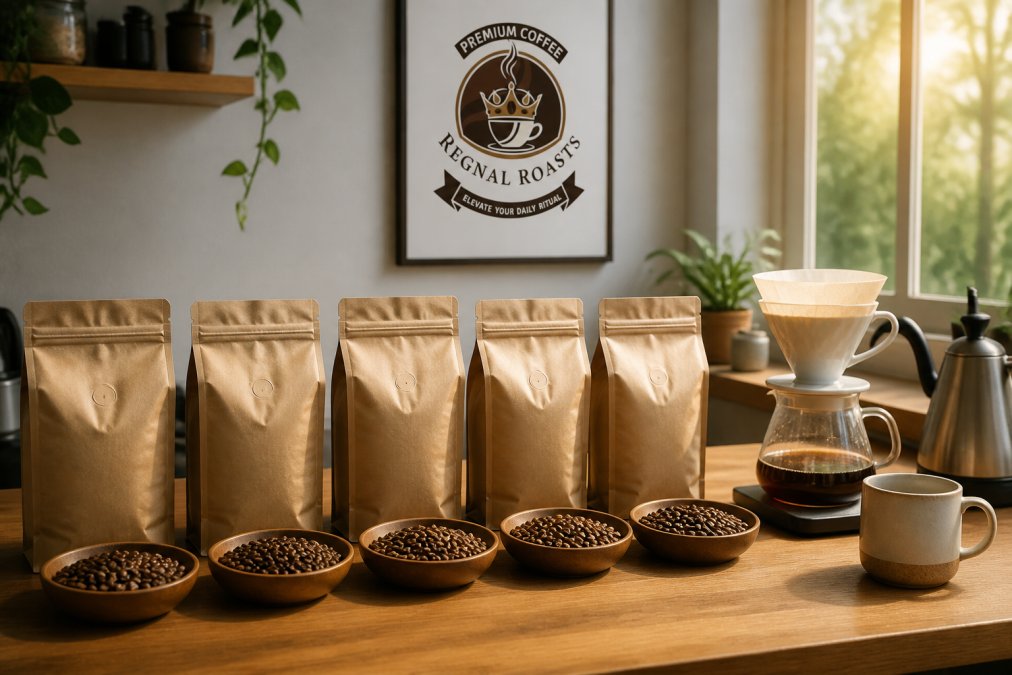
Regnal Roasts offers five single-origin coffees, each roasted to a different profile and priced at $158.02 per order. The lineup spans medium-dark to medium-light, so the choice comes down to how you brew and how you like your cup.
| Coffee | Roast Level | Tasting Notes | Best For |
|---|---|---|---|
| Bali Blue | Medium-Dark | Dark chocolate, molasses, brown sugar | Milk drinks and black sipping |
| Brazil Santos | Medium | Smooth, rich cocoa | Everyday drip and espresso |
| Colombia | Medium | Dried orange, berry, chocolate | Balanced daily ritual |
| Costa Rica | Medium | Sweet apple, raisin, honey | Bright, approachable cups |
| Ethiopia Natural | Medium-Light | Milk chocolate, fruity, caramel | Pour-over and French press |
Bali Blue: Medium-Dark Roast for Milk and Black Sipping
Bali Blue is a medium-dark single origin from the Kintamani highlands, grown at 1,200 to 1,600 meters on volcanic loam. Smallholder farmers hand-pick and wet-hull the beans, then dry them on raised beds.

Brazil Santos and Colombia: Medium Roasts Built for Daily Ritual
Brazil Santos and Colombia are the two medium roasts that anchor a daily routine. Brazil Santos comes from three estates in Paraná and São Paulo, pulped natural and sun-dried for a naturally sweet, cocoa-forward cup. Colombia, grown above Medellín at 1,300 to 1,500 meters, brings dried orange and berry up front with a chocolate finish.
Costa Rica and Ethiopia Natural: Brighter, Fruitier Profiles
Costa Rica and Ethiopia Natural are the brighter end of the range. Costa Rica, from micro farms in Alajuela, opens with sweet apple and raisin before settling into honey. Ethiopia Natural, from the Sidama Zone at 1,700 to 1,900 meters, is a medium-light roast with milk chocolate, caramel, and a fruity sweetness that needs nothing added.
How to Tell If Coffee Beans Are Fresh
Fresh coffee beans show three reliable signs: a visible roast date within the last few weeks, a strong aroma when you open the bag, and a slight sheen of oil on darker roasts. If the bag is puffed tight and smells flat, the beans are past their best.
How to Store Coffee Beans for Freshness
Store coffee beans in an airtight, opaque container at room temperature, away from light, heat, and moisture. That single habit protects more flavor than any gadget, but the details of why each rule exists are what separate a bag that stays good for three weeks from one that fades in ten days.
The Four Enemies of Fresh Coffee
Oxygen is the primary driver of staling. It reacts with the oils on the bean surface in a process called oxidation, producing the cardboard-and-paper flavors people describe as "stale." The more air contact, the faster the decline.
Container Choices, Ranked
- Original bag with a one-way valve (best for daily use): The valve lets CO2 escape without letting oxygen in, and the bag is usually opaque and resealable. Fold the top down and clip it, or transfer to a valve-equipped canister.
- Airtight opaque canister (best for counter storage): Ceramic or stainless steel with a gasket seal works well. Avoid clear glass unless it lives in a dark cabinet.
- Vacuum-sealed bags (best for long-term storage): Removing air slows oxidation dramatically. Good for buying in bulk, but you'll need to reseal after opening.
- Fridge (avoid): The refrigerator cycles through temperature and humidity changes every time the door opens, and coffee absorbs odors from surrounding food. There's no upside.
- Freezer (only for long-term, unopened storage): See below.
The Freezer Question, Answered Properly
The freezer is the most misunderstood storage option. It works, but only under specific conditions.
Practical Habits That Actually Move the Needle
- Buy in amounts you'll finish within two to four weeks. Freshness is a use-it-or-lose-it resource.
- Grind right before brewing. Ground coffee exposes far more surface area to oxygen, so it stales in days rather than weeks. Whole bean holds its flavor far longer because the surface area exposed to air is smaller.
- Keep the bag sealed between uses. Every minute a bag sits open is a minute of oxidation.
- Don't store beans in the hopper of a grinder for long periods. Hopper lids are rarely airtight, and light exposure through clear hoppers is a real factor.
- Label the roast date if you transfer beans. Once they leave the original bag, the date is the first thing you lose.
The FDA guidance on safe food storage reinforces the same principle for pantry goods: stable temperature and sealed containers slow degradation. Coffee is no different, it just degrades faster and more noticeably than most pantry items.
Sustainability and Ethical Sourcing in Fresh Roasted Coffee
Sustainability in coffee comes down to how growers are paid and how land is farmed. Direct trade and fair trade models shorten the chain between farmer and roaster, and many specialty roasters now publish sourcing details for each lot.
Which Fresh Roasted Coffee Beans Should You Choose?
Choose by brew method and taste preference, not by price alone. If you drink milk-based coffee, Bali Blue's medium-dark profile holds up. For a balanced daily cup, Brazil Santos or Colombia fit almost any setup. If you want brightness and fruit, Costa Rica and Ethiopia Natural deliver it.

Frequently Asked Questions
Are fresh roasted coffee beans better than pre-ground coffee?
Whole bean fresh roasted coffee holds its flavor far longer than pre-ground because grinding exposes the oils and aromatics to oxygen. Once ground, coffee can lose noticeable aroma within hours. Buying whole bean and grinding right before brewing preserves the tasting notes roasters worked to develop. If you use a single-serve machine, look for K-Cup compatible pods sealed soon after roasting, like Regnal Roasts offers, to get closer to that just-ground experience.
How long do fresh roasted coffee beans stay fresh?
Most roasters agree that fresh roasted coffee beans hit peak flavor between 4 and 14 days after the roast date. After about 3 to 4 weeks, the aromatic oils fade and the cup tastes flatter. Whole bean coffee stored in an airtight container away from light, heat, and moisture can hold acceptable quality for 4 to 6 weeks. Beyond that, you are drinking coffee, not fresh roasted coffee.
What should I look for on a bag of fresh roasted coffee beans?
Check three things: the roast date, the origin, and the tasting notes. A roast date tells you exactly when the beans left the roaster, which matters more than a generic best-by date. Origin details like altitude and processing method explain why a coffee tastes the way it does. Regnal Roasts lists all of this on each bag, from the 1,200-1,600 meter growing altitude of Bali Blue to the cocoa notes of Brazil Santos.
How do I store fresh roasted coffee beans to maintain flavor?
Keep beans in an opaque, airtight container at room temperature, away from the stove, direct sun, and the fridge. Freezing works if you seal beans in a vacuum bag and use them within a month without thawing and refreezing. Buy in sizes you will finish within 2 to 3 weeks.
Can I try fresh roasted coffee beans before committing to a subscription?
Yes. Regnal Roasts sells single bags starting at $158.02, so you can order one roast, brew it, and decide before subscribing. Start with a medium roast like Brazil Santos or Colombia if you drink coffee black, or Bali Blue if you add milk. Once you know which tasting notes you prefer, a subscription makes more sense because you can time deliveries to your actual consumption rate.
Fresh roasted coffee beans reward a little attention: check the roast date, store them well, and drink them while they still bloom. Regnal Roasts handcrafts small-batch single origins and offers K-Cup compatible pods for anyone who wants that freshness without giving up convenience. Explore the five-roast lineup, from bold Bali Blue to bright Ethiopia Natural, and find the profile that fits your morning. Subscribe to our emails and reign over your mornings.