

Are Compostable K-Cup Pods Worth It?
Table of Contents
- What Compostable K-Cup Pods Are Made Of
- Compostable vs Recyclable Coffee Pods: Key Differences
- Cost Per Cup: Real Pricing Breakdown
- How to Compost K-Cup Pods at Home and Commercially
- Commercially Compostable Coffee Pods vs Home Composting
- Reusable K-Cup Filters vs Compostable Pods: Environmental Trade-Offs
- Brew Quality and Freshness: Do Compostable Pods Deliver?
- The Verdict: Is the Investment Worth Your Morning Ritual?
- Frequently Asked Questions
Last Updated: October 9, 2026
What Compostable K-Cup Pods Are Made Of
Compostable K-Cup pods replace traditional plastic with plant-based materials designed to break down in the right environment. The shell typically uses polylactic acid (PLA), a bioplastic derived from corn starch or sugarcane, instead of the petroleum-based plastics found in standard single-use coffee pods. The filter inside holds your ground coffee and is usually made from cellulose or other plant fibers that decompose alongside the pod shell.
The key difference lies in construction. While a regular K-Cup pod is engineered to last indefinitely on a shelf, compostable coffee pods are built with decomposition in mind. Many brands use nitrogen-flushed packaging to maintain coffee freshness while keeping the overall pod structure compostable. This nitrogen seal prevents oxygen from degrading the coffee grounds, ensuring you get the same bold flavor and extraction quality as traditional pods.
The materials matter because they determine where and how quickly the pod breaks down. A compostable pod made from PLA will decompose in a commercial composting facility within 180 days under the right conditions. At home, the timeline stretches significantly longer, sometimes years, because residential compost piles don't reach the heat and microbial activity required for industrial decomposition.
Compostable vs Recyclable Coffee Pods: Key Differences
The distinction between compostable and recyclable pods is crucial because they require completely different disposal methods. Compostable pods are designed to break down into natural compounds in a composting environment. Recyclable pods, by contrast, are collected, sorted, and reprocessed into new plastic products through mechanical or chemical recycling.
Here's where the confusion starts: many coffee pods marketed as "eco-friendly" are actually recyclable, not compostable. Recyclable pods still contain plastic, but the material can theoretically be reused. The problem is logistics. Most curbside recycling programs don't accept coffee pods because they're too small and get tangled in sorting machinery. You'd need to find a specialized pod-recycling program, which exists in some areas but remains inconvenient for most households.
Compostable pods avoid this friction. You toss them into a compost bin, home or commercial, and they disappear into the soil. But here's the catch: home composting breaks down compostable pods much more slowly than commercial facilities, and many home compost piles never reach the temperatures needed for complete decomposition.
The environmental trade-off isn't obvious. A recyclable pod might seem wasteful, but if recycling infrastructure actually processes it, the plastic gets reused rather than sitting in a landfill for centuries. A compostable pod sounds better but only delivers that benefit if it reaches a commercial composting facility, which most don't, because municipal programs don't accept them and most households lack access to industrial composting.
| Aspect | Compostable Pods | Recyclable Pods |
|---|---|---|
| Material | Plant-based (PLA, cellulose) | Plastic or aluminum |
| Home Disposal | Slow (months to years) | Not accepted in curbside programs |
| Commercial Facility | 180 days or less | Processed into new plastic |
| Infrastructure Required | Commercial composting access | Specialized pod recycling program |
| Environmental Outcome | Soil amendment | Material reuse |
| Landfill Risk | Lower if composted | Higher without recycling access |
Cost Per Cup: Real Pricing Breakdown
This is where compostable K-Cup pods hit a real barrier for most households. Let's look at actual pricing to understand the financial commitment.
At Regnal Roasts, our 12-pack of K-Cup compatible pods costs $17.65, which breaks down to approximately $1.47 per cup. Our 60-pack drops to $0.93 per cup, a meaningful savings for regular drinkers. Both options use nitrogen-sealed freshness to lock in peak flavor from roast to brew, and both are compatible with standard K-Cup brewers.

For comparison, a typical grocery-store K-Cup pod from a mass-market brand costs between $0.75 and $1.25 per cup. The premium for specialty coffee, whether compostable or not, usually runs $1.00 to $1.75 per cup. So compostable options aren't inherently more expensive than quality coffee pods; the cost difference depends on the roast quality, origin, and brand positioning.
The real financial question is volume. If you brew one pod daily, that's 365 pods per year. At our pricing, you're looking at roughly $340 annually for a premium blend (based on the 60-pack price). A household using cheaper pods might spend $275 to $450, depending on quality. Over five years, the difference compounds, but it's not the compostability driving the cost, it's the coffee itself.
How to Compost K-Cup Pods at Home and Commercially
The disposal method you choose determines whether a compostable pod actually becomes compost or ends up in a landfill. Understanding both options helps you decide if compostable K-Cup pods fit your lifestyle.
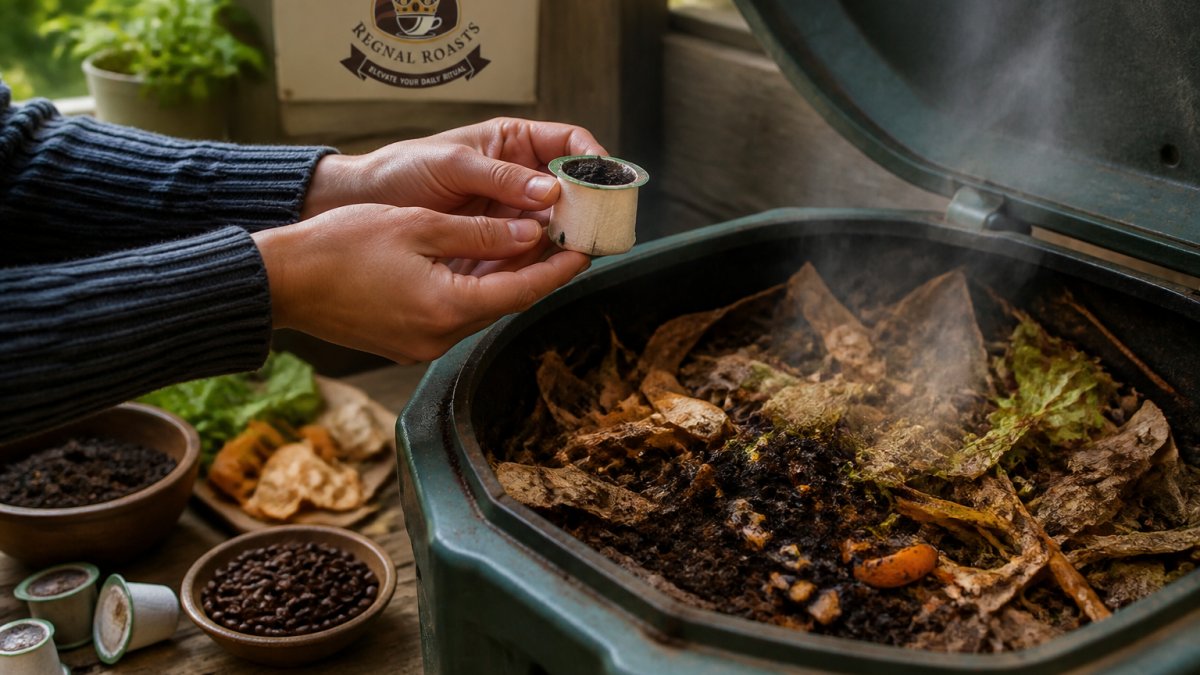
Home Composting: If you maintain a backyard compost pile, you can add compostable pods directly. Remove any aluminum or plastic components first, most compostable pods have a filter basket that may need separation. Toss the PLA shell and cellulose filter into your active compost pile alongside food scraps, yard waste, and other organic material. The decomposition timeline depends on your pile's temperature, moisture, and microbial activity. In an actively managed pile (turned regularly, kept moist, reaching 130-150°F), a compostable pod might break down in 6-12 months.
The challenge is that home compost piles rarely reach the sustained heat required for complete PLA decomposition. You might end up with partially broken-down pod fragments mixed into your finished compost.
Commercial Composting: Industrial facilities maintain precise conditions, high heat (160°F+), controlled moisture, and optimized microbial environments. Under these conditions, compostable K-Cup pods decompose within 90-180 days. The resulting compost is free of plastic fragments and can be used for landscaping or agricultural applications.
The barrier is access. Municipal composting programs exist in some cities and regions but remain unavailable in most. Check your local waste management authority to see if commercial composting is offered. Some programs accept compostable pods; others don't, because they've had problems with contamination or mislabeling.
Commercially Compostable Coffee Pods vs Home Composting
This section addresses a critical reality: most compostable K-Cup pods never reach a commercial composting facility, which means they don't fully deliver on their environmental promise.
Commercially compostable pods are certified to break down completely under industrial conditions. The certification (ASTM D6400 or equivalent) guarantees that within 180 days at a facility reaching 140°F with proper aeration and moisture, the pod will decompose into carbon dioxide, water, and biomass.
Home composting is messier. Your backyard pile operates at lower, more variable temperatures. Even if it reaches 120-130°F on a hot day, it won't sustain that temperature consistently. Compostable pods designed for 160°F industrial conditions may never fully break down at home. You'll end up with a pile of finished compost containing visible PLA fragments.
This is the uncomfortable truth: choosing compostable K-Cup pods only makes environmental sense if you have access to commercial composting and actually use it.
Reusable K-Cup Filters vs Compostable Pods: Environmental Trade-Offs
If you're concerned about single-use waste, reusable K-Cup filters deserve serious consideration. These mesh or metal filters hold ground coffee and fit into your brewer just like a disposable pod, but you refill them with fresh grounds after each brew and wash them between uses.
The environmental case for reusables is straightforward: zero packaging waste per cup after the initial purchase. A reusable filter costs $15-30 upfront and lasts years. Over 365 brews per year, that's pennies per cup with no ongoing waste. Compare this to compostable pods, where you're buying and disposing of packaging every single time, even if it breaks down eventually.
But reusables introduce friction. You need to grind fresh coffee (or buy pre-ground), measure it, fill the filter, clean it after each brew, and store it. Compostable pods offer convenience, drop, brew, dispose, which appeals to most households.
There's also a quality consideration. Precision-engineered filters in disposable pods, including those in our Regnal Roasts K-Cup compatible line, are designed to maximize extraction at specific flow rates. Reusable filters vary widely in mesh size and design. Some deliver excellent brew quality; others produce weak, inconsistent cups.
The honest trade-off: reusable filters eliminate packaging waste but demand daily effort. Compostable pods reduce waste (if properly composted) while keeping your morning routine simple.
Brew Quality and Freshness: Do Compostable Pods Deliver?
A legitimate concern: do compostable materials compromise coffee freshness or brew quality? The answer is no, provided the pod uses proper preservation methods.
Nitrogen flushing, the technique of sealing pods in an oxygen-free environment, preserves coffee freshness regardless of whether the pod is plastic or compostable. At Regnal Roasts, our K-Cup compatible pods use nitrogen-sealed freshness to lock in peak flavor from roast to brew. The nitrogen prevents oxidation, which is what stales coffee.
Brew quality depends on the filter design and coffee-to-water ratio, not the pod's compostability. A well-engineered compostable pod delivers the same extraction as a plastic one. The precision-engineered filter in our pods is designed to maximize extraction without slowing your brew, so every drop is bold and balanced, whether you're brewing our Original Roast signature blend or a single-origin Mexican or Peruvian option.

Where compostable pods sometimes fall short is in shelf stability. Some plant-based materials are slightly more permeable than petroleum plastics, which can allow microscopic amounts of oxygen to penetrate over very long storage periods.
If freshness is your priority, check the roast date on the packaging and buy from roasters who prioritize quality. The material is secondary to how the coffee was roasted and sealed.
The Verdict: Is the Investment Worth Your Morning Ritual?
Compostable K-Cup pods are worth it if three conditions are met: you have access to commercial composting, you'll actually use that service, and you value the convenience of single-serve brewing enough to justify the ongoing packaging waste.
If you lack commercial composting access or won't commit to using it, compostable pods offer minimal environmental benefit over standard plastic.
If you're flexible on convenience, reusable K-Cup filters eliminate packaging waste entirely, but they require daily effort and may compromise brew quality depending on the filter design.
If you want premium coffee without compromise, specialty pods from roasters like Regnal Roasts deliver the freshness, flavor, and convenience of standard K-Cups. Our K-Cup compatible pods, whether the 12-pack at $17.65 or the 60-pack at $55.77, use nitrogen-sealed freshness and precision-engineered filters to maximize extraction. Single-origin options like our Mexican, Peruvian, and Bali blends offer the complexity and depth you'd expect from specialty roasts.

The practical recommendation: if commercial composting is available in your area, compostable pods align your morning ritual with your environmental values. If it's not, either invest in a quality reusable filter or accept that convenience comes with packaging waste. Either way, prioritize coffee quality, that's where the real difference in your daily experience lies.
K-Cup compatible pods make sense for households with access to commercial composting infrastructure and the commitment to use it. At Regnal Roasts, we've crafted our K-Cup compatible pods to deliver the freshness, flavor, and sustainability you're looking for. Explore our handcrafted blends, from our signature Original Roast to single-origin options from Mexico, Peru, and Bali, and experience the kind of premium coffee that elevates your daily ritual. Subscribe to our emails to discover new roasts and stay updated on sustainable coffee practices.
Frequently Asked Questions
Are compostable K-Cup pods actually compostable?
True compostable K-Cup pods break down in industrial composting facilities within 180 days under specific heat and moisture conditions. However, most home compost bins don't reach the required temperature (140°F+), so they won't fully decompose there.
How do compostable K-Cup pods compare to regular pods in environmental impact?
Compostable pods eliminate persistent plastic waste but require industrial composting infrastructure to deliver that benefit. If sent to landfill instead, they decompose slowly without producing useful compost. Regular plastic K-Cup pods persist for decades. The real environmental win depends on whether your area has commercial composting access.
What's the cost difference between compostable and standard K-Cup pods?
Regnal Roasts Original Roast 12-pack runs $17.65 ($1.47 per cup), and the 60-pack is $55.77 ($0.93 per cup).
Can I compost K-Cup pods in my home compost bin?
Most home compost bins cannot fully compost K-Cup pods because they don't reach the 140°F+ temperature required for industrial standards. You can remove the grounds and compost those separately, then recycle or discard the pod shell. Check your local waste management for commercial composting programs.