

What Makes Specialty Coffee Pods Different
Table of Contents
- How Specialty Coffee Pods Are Defined
- Coffee Sourcing, Origin, and Traceability
- Harvesting, Processing, and Roasting Quality
- Flavor, Aroma, and Tasting Notes
- Coffee Pod Freshness and Packaging Performance
- Coffee Pods vs. K-Cups: What's the Real Difference
- How to Choose Coffee Pods for Your Taste and Machine
- Best Coffee Pods for Keurig and Single-Serve Brewers
- Frequently Asked Questions
Last Updated: October 10, 2026
How Specialty Coffee Pods Are Defined
Specialty coffee pods are single-serve capsules built from beans scoring 80+ on the Specialty Coffee Association's cupping scale, a standardized evaluation of aroma, acidity, body, balance, flavor, aftertaste, and overall impression. Standard supermarket pods use commodity-grade beans below this threshold. At Regnal Roasts, we define specialty coffee pods as carefully selected, precisely packaged, and freshly roasted to deliver distinctive flavor in every brew.
Small-batch roasting allows roasters to dial in precise profiles that highlight each bean's unique characteristics.
Specialty coffee pods use nitrogen-sealed capsules that create an oxygen-free environment, preventing oxidation and flavor degradation.
Coffee Sourcing, Origin, and Traceability
Specialty coffee pods trace beans to specific regions, farms, or cooperatives.
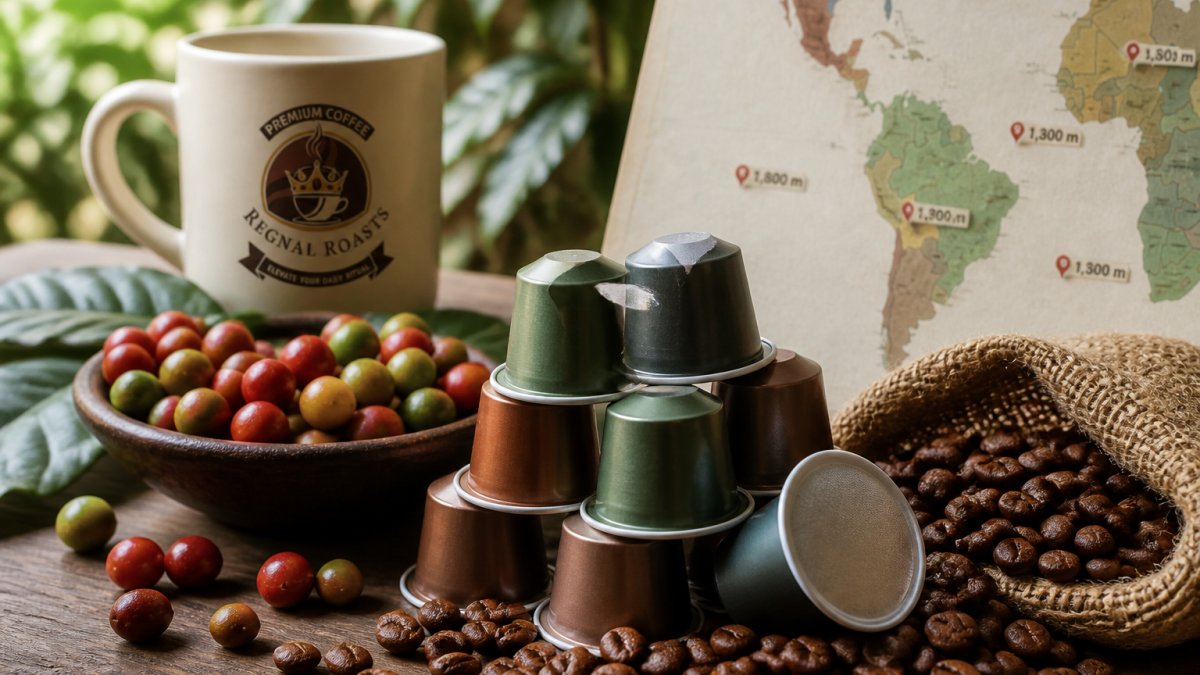
Altitude, soil, rainfall, and temperature all shape final flavor. A bean grown at 1,400-1,900 meters in Chiapas develops different acidity and sweetness than one from Bali's volcanic loam at 1,200-1,600 meters.
Single-Origin vs. Blended Beans
Single-origin pods showcase what one region's altitude, soil, and climate produce. Blended pods combine beans from multiple origins to achieve balance and complexity, like Regnal Roasts' Original Roast, a signature blend designed to deliver richness and depth in every cup.
Varietal Selection and Growing Conditions
Coffee varietals influence flavor as much as origin. Bourbon offers sweetness and smoothness; Typica brings complexity and acidity. Growing conditions, altitude, shade coverage, soil minerals, and harvest timing further refine the final taste.
Harvesting, Processing, and Roasting Quality
How coffee cherries are harvested and processed directly impacts the final cup. Specialty coffee pods use beans processed with care and precision, not speed and volume.
Hand-Picking and Processing Methods
Specialty coffee relies on selective hand-picking. Workers choose only ripe cherries, leaving unripe or overripe fruit on the tree.
Washed processing produces clean, bright flavors. Wet-hulled and sun-dried methods, like those used for Bali coffee, create deeper, fuller, more complex profiles.

Small-Batch Roasting and Roast Freshness
Small-batch roasting allows precise control of temperature, airflow, duration, and cooling speed. Coffee reaches peak flavor 3-5 days after roasting.
Flavor, Aroma, and Tasting Notes
Specialty pods deliver distinctive tasting notes, lemon and dark chocolate in Mexican Chiapas, salted caramel and bright citrus in Peruvian, reflecting growing conditions, varietal selection, processing, and roasting precision. Rich, complex aroma signals freshness; flat, generic scent signals oxidation.
Coffee Pod Freshness and Packaging Performance
Freshness is where specialty coffee pods diverge most visibly from standard supermarket options, but the difference is measurable, not just marketing.
Roast Date and Peak Flavor Window
Specialty coffee reaches peak flavor 3-5 days after roasting, when CO₂ has stabilized but volatile aromatic compounds remain intact.
Specialty coffee roasters print roast dates on their pods. Standard supermarket pods rarely display roast dates; many have been in distribution for 2-4 months before reaching shelves, meaning they're already well past peak flavor when you brew them.
Oxygen Barrier and Oxidation Prevention
Standard K-Cup pods use minimal oxygen barriers; oxygen permeates over weeks, creating stale, cardboard-like notes. Specialty pods use nitrogen flushing and aluminum or metallized film layers that block 99%+ of oxygen.
Storage Conditions and Shelf Life
Store specialty pods at 50-70°F, 30-50% humidity, away from direct sunlight.
Moisture Barrier and Humidity Sensitivity
Coffee is hygroscopic and absorbs water from air. Specialty pods use moisture barriers keeping internal humidity below 5%; standard pods offer minimal protection.
Practical Freshness Verification
Look for: printed roast date, nitrogen-sealed packaging, opaque or foil-lined packaging, sealed intact capsule, and storage instructions. Pods lacking roast dates, using transparent packaging, or without nitrogen sealing are commodity coffee, not specialty.
Coffee Pods vs. K-Cups: What's the Real Difference
Many specialty coffee pods are K-Cup compatible, meaning they work in Keurig brewers but aren't manufactured by Keurig. Five concrete criteria separate specialty pods from standard K-Cups.

Bean Quality and Grading
Standard K-Cups use beans scoring below 80 on the SCA cupping scale; specialty pods use 80+. A 5-point difference translates to noticeably cleaner, more complex cups.
Sourcing Transparency and Traceability
Standard K-Cups source from commodity brokers with no traceability; specialty pods trace beans to specific regions, farms, or cooperatives. Verify: specialty labels show "Chiapas, Mexico" or "Piura, Peru" or cooperative names. Generic "coffee blend" labels indicate commodity coffee.
Roasting Approach and Freshness
Standard K-Cups are roasted in large batches by industrial roasters, then packaged and distributed through warehouses and retail channels. This process takes weeks. By the time a standard K-Cup reaches a store shelf, it is often 6-12 weeks old. Roast dates are not printed.
Specialty coffee pods are roasted in small batches by specialty roasters, then packaged immediately in nitrogen-sealed capsules. Roast dates are always printed on the package.
How to verify: Check for a roast date. If there is none, the coffee is not specialty.
Packaging and Oxygen Barrier
Standard K-Cups use a paper filter and plastic shell. The oxygen barrier is minimal. Oxygen permeates the pod over weeks, degrading flavor. A standard K-Cup opened after sitting on a shelf for 3 months will taste noticeably flat and stale.
Specialty coffee pods use nitrogen flushing and multi-layer barriers (often aluminum or metallized film). These create an oxygen barrier 50-100 times more effective than standard K-Cups. Flavor is preserved.
How to verify: Look for "nitrogen flushed" or "nitrogen sealed" on the package. Specialty pods often use foil or opaque packaging; standard K-Cups often use transparent plastic.
Flavor Profile and Extraction
Standard K-Cups deliver a generic, one-dimensional cup. The flavor is often described as "coffee-flavored water", present but flat, with little acidity, body, or complexity. This is partly because commodity beans are lower quality, but also because they've oxidized during storage and distribution.
Specialty coffee pods deliver a distinctive, multi-layered cup. You taste origin characteristics (citrus from a Peruvian bean, chocolate from a Bali bean), varietal traits (brightness from a Bourbon, complexity from a Typica), and roasting precision (acidity is bright but not sharp, body is full but not heavy).
How to verify: Brew both side by side. A specialty pod will show noticeably more aroma, more flavor complexity, and a longer, cleaner finish. The difference is not subtle.
Cost Per Serving and Value Proposition
Standard K-Cups cost $0.50-$0.80 per pod, or roughly $0.50-$0.80 per 8-10 oz cup.
Specialty coffee pods cost $1.00-$1.50 per pod, or roughly $1.00-$1.50 per 8-10 oz cup.
This is a 2-3× price premium. Whether it's worth it depends on your priorities. If you drink coffee for caffeine, standard K-Cups are adequate. If you drink coffee for flavor, the premium is justified: you're getting beans that are higher quality, roasted days ago instead of months ago, and packaged to preserve freshness.
Summary: The Real Difference
Standard K-Cups are commodity coffee in a convenient format. Specialty coffee pods are specialty coffee in a convenient format. The difference is not the pod itself, it's what's inside and how it's treated. A specialty pod brewed in a Keurig machine delivers a cup closer to what you'd get from a specialty espresso bar than what you'd get from a standard supermarket pod.
How to Choose Coffee Pods for Your Taste and Machine
Start by identifying your machine compatibility. Most single-serve brewers accept K-Cup compatible pods, but verify yours before ordering.

Next, consider your taste preferences. Do you prefer bright, acidic coffees with citrus notes, or fuller-bodied, chocolatey cups? Single-origin pods showcase regional characteristics, while blends offer balance and consistency. Regnal Roasts offers both: single-origin options like Mexican, Peruvian, and Bali pods, plus the Original Roast blend for those who want richness and depth in every cup.
Roast level matters too. Light roasts preserve acidity and origin characteristics. Medium roasts offer balance. Medium-dark and dark roasts emphasize body and chocolate or molasses notes. Bali pods are medium-dark, delivering bold flavors that stand up to milk and cream. Mexican and Peruvian pods offer medium roasts with bright, layered profiles.
Finally, consider freshness and packaging. Look for pods sealed in nitrogen, roasted recently, and stored properly. Check whether the roaster provides roast dates.
Best Coffee Pods for Keurig and Single-Serve Brewers
For those seeking specialty coffee pods that work seamlessly with Keurig and compatible brewers, several options deliver exceptional results.
The Original Roast from Regnal Roasts ($17.65 for 12 pods, $55.77 for 60 pods) is a masterfully crafted signature blend of premium gourmet coffees designed for those who refuse to compromise on their daily cup. Each capsule is nitrogen-sealed for peak freshness and features a precision-engineered filter that maximizes extraction without slowing your brew. The 60-pack offers the best value for regular drinkers who want to stock up.
For single-origin exploration, Regnal Roasts' Mexican pods ($17.65) showcase Chiapas beans at 1,400-1,900 meters with tasting notes of lemon, brown sugar, and dark chocolate. The washed process delivers a clean, vibrant cup that rewards you from the first sip to the last.
The Peruvian pods ($17.65) bring silky sweetness and bright citrus finish from the mountains of Piura and Amazonas. Grown by Cooperativa Agrícola de Servicios Norandino and processed using gully-washing and sun-drying, these medium-roast pods deliver a smooth, layered profile that defies the limitations of single-serve brewing.
For those drawn to deeper, more complex flavors, the Bali pods ($17.65) showcase volcanic terroir. Grown by smallholder farmers in Kintamani at 1,200-1,600 meters and processed using hand-picking, wet-hulling, and raised-bed drying, these medium-dark roasts deliver dark chocolate, molasses, and brown sugar notes. The traditional processing deepens flavor and creates layers of complexity.
| Pod Type | Origin | Tasting Notes | Roast Level | Best For |
|---|---|---|---|---|
| Original Roast | Blend | Rich, full-bodied | Medium | Daily consistency |
| Mexican | Chiapas | Lemon, brown sugar, dark chocolate | Medium | Bright, balanced profiles |
| Peruvian | Piura & Amazonas | Salted caramel, citrus finish | Medium | Smooth, layered cups |
| Bali | Kintamani | Dark chocolate, molasses, brown sugar | Medium-Dark | Bold, complex flavors |
Frequently Asked Questions
What makes coffee specialty grade?
Specialty coffee pods are defined by traceable sourcing, specific varietals, hand-picking or selective harvesting, and intentional processing methods that preserve flavor complexity. Unlike standard pods sourced from commodity-grade beans, specialty pods feature single-origin or carefully curated blends with documented growing conditions, altitude, and soil type. The beans must be roasted fresh in small batches to lock in the distinctive tasting notes, lemon, chocolate, caramel, or citrus, that reflect the origin's character. Roasters like Regnal Roasts prioritize this precision to deliver a cup with depth and distinction.
Do specialty coffee pods taste fresher than regular ones?
Yes. Specialty coffee pods use nitrogen-sealed packaging and small-batch roasting, which preserves peak flavor longer than mass-produced alternatives. Standard supermarket pods often sit in warehouses for months before reaching your cup, allowing oxidation to dull the aroma and flatten the taste profile. Specialty roasters roast to order and seal pods immediately, locking in volatile aromatic compounds. Nitrogen flushing removes oxygen, preventing degradation. The result is a noticeably brighter, more complex cup compared to stale commodity pods.
Are specialty coffee pods compatible with Keurig machines?
Yes, most specialty coffee pods are designed as K-Cup compatible, meaning they work with standard Keurig brewers and similar single-serve machines. Regnal Roasts offers K-Cup compatible pods across its lineup, including the Original Roast blend and single-origin options from Mexico, Peru, and Bali. The precision-engineered filter inside each pod is designed to maximize extraction without slowing your brew, so you get café-quality results without needing a different machine. Compatibility is a key advantage of specialty pods, they deliver premium flavor through equipment you already own.
Are specialty coffee pods worth the cost compared to standard pods?
The value depends on your priorities. Specialty pods typically cost $17.65 per box of 12 at Regnal Roasts, roughly $1.47 per cup, versus $0.50-$0.80 for mass-market alternatives. However, specialty pods deliver superior flavor complexity, longer freshness, and traceability that justify the premium for discerning coffee drinkers. For remote workers and home-centric individuals who value ritual and taste, the daily investment in a premium pod often outweighs the cost savings of cheaper options, especially when a subscription or bulk purchase like the 60-pack at $55.77 locks in consistent quality.
Choosing specialty coffee pods means prioritizing freshness, traceability, and intentional roasting over convenience alone. Regnal Roasts delivers all three. Our handcrafted blends and single-origin selections are nitrogen-sealed for peak freshness and designed for K-Cup compatible brewers, ensuring that every cup elevates your daily ritual. Discover the perfect roast to savor life's finer flavors, start with a sampler to find your signature blend.