

Make Single-Serve Coffee Taste Less Watery
Table of Contents
- Why Your Single-Serve Coffee Tastes Watery
- Master the Best Coffee-to-Water Ratio for Single Serve
- Grind Size and Extraction: The Foundation of Bold Flavor
- Water Temperature and Steep Time for Full-Bodied Results
- How to Clean Your Coffee Maker for Better Taste
- High-Quality Coffee Pods vs Grocery Store Brands
- Choosing the Right Roast Profile for Cafe-Quality Depth
- Frequently Asked Questions
Last Updated: September 22, 2026
Why Your Single-Serve Coffee Tastes Watery
Single-serve machines are convenient, but they often produce thin, weak coffee. The problem isn't the machine itself, it's how most people use it.
Your coffee tastes watery because water moves through the grounds too fast, leaving flavor behind and producing a hollow cup compared to cafe coffee.
The good news: small adjustments to your ratio, grind size, water temperature, and brew time transform single-serve coffee into something bold and rich.
The difference between watery and bold comes down to extraction. When water passes through grounds too quickly, it doesn't extract the oils, acids, and compounds that create mouthfeel and complexity. Slow it down, and everything changes.
Master the Best Coffee-to-Water Ratio for Single Serve
The best coffee-to-water ratio for single-serve machines is 1:15 to 1:17 by weight. This means for every gram of coffee, use 15 to 17 grams of water. Most people use far too much water, which dilutes the final cup.
Here's how to measure correctly:
- Use a kitchen scale, not guesswork. Eyeballing water and grounds leads to inconsistent results.
- For a 10-ounce cup, start with 0.6 ounces (17 grams) of coffee grounds.
- Fill your machine with 10 ounces (283 grams) of water.
- Brew and taste. If it's still weak, reduce water by half an ounce next time.
Most single-serve pods come pre-measured for volume, not flavor. Standard K-Cups use ratios closer to 1:20 or 1:25, too dilute for bold coffee.
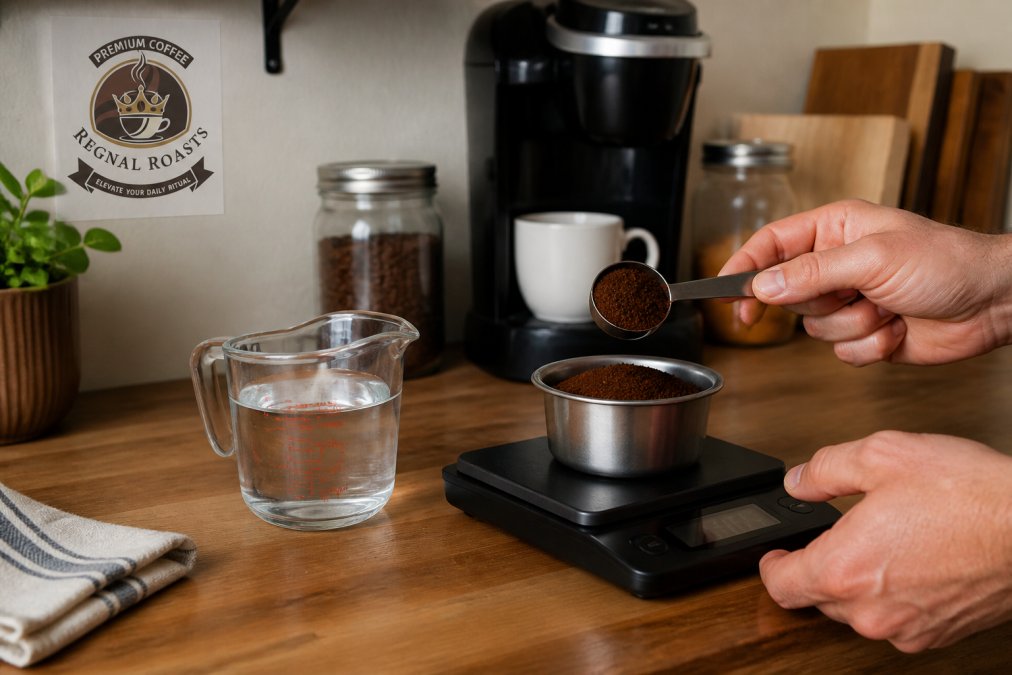
If your machine doesn't let you adjust water amount, use less coffee in a reusable pod and fill the cup three-quarters full for stronger coffee.
Grind Size and Extraction: The Foundation of Bold Flavor
Grind size controls water flow: finer grinds slow it, coarser grinds speed it up.
For single-serve machines, use a medium-fine grind, finer than drip but not powder, to create surface area while keeping flow slow enough for proper extraction.
Diagnosing Your Extraction Problem: Sour vs. Bitter
Before adjusting grind size, diagnose whether your watery coffee is under-extracted or over-extracted, as they require opposite fixes.
Under-extracted coffee (sour, thin, watery):
- Tastes sharp, acidic, or sour on the tongue
- Feels thin and hollow in your mouth
- Lacks sweetness and body
- Often accompanied by a papery or grassy aftertaste
- This is the most common problem in single-serve machines
Over-extracted coffee (bitter, muddy, harsh):
- Tastes bitter, astringent, or burnt
- Feels heavy but unpleasant in your mouth
- Lacks brightness or nuance
- Often accompanied by a dry, chalky finish
- Rare in single-serve machines but possible with very fine grinds or extended brew times
Brew a test cup and hold it in your mouth for 2-3 seconds. Sour taste and thin mouthfeel indicate under-extraction; bitter taste and heavy mouthfeel indicate over-extraction.
Adjusting Grind Size Based on Your Diagnosis
If your coffee tastes sour or thin, go finer. A finer grind increases surface area and slows water flow, giving the grounds more time to release flavor compounds. Move down one grind setting on your burr grinder and brew again.
If your coffee tastes bitter or harsh, go coarser. A coarser grind decreases surface area and speeds water flow, reducing the time water spends in contact with the grounds. Move up one grind setting and brew again.
Make one adjustment at a time and wait 24 hours before the next change so you can accurately taste the difference.
Why Consistency Matters as Much as Size
Burr grinders produce uniform particle size for consistent extraction. Blade grinders create uneven particles that over-extract (bitter) and under-extract (sour) simultaneously, producing watery, confused-tasting coffee.
Burr grinders (either flat or conical) produce uniform particle size. This means all the grounds extract at roughly the same rate, creating balanced, full-bodied flavor instead of the thin, sour taste that plagues single-serve brewing.
Upgrading from a blade grinder to a burr grinder often solves watery coffee on its own, one of the highest-impact changes you can make.
Water Temperature and Steep Time for Full-Bodied Results
Water temperature should be between 195°F and 205°F for optimal extraction. Most single-serve machines reach this automatically, but some run cooler.
If your machine has a temperature setting, aim for 200°F. Cooler water produces sour, thin coffee; hotter water can over-extract and create bitterness.
Steep time, how long water stays in contact with grounds, matters as much as temperature. Aim for 3 to 4 minutes of total contact time for proper extraction.
If your machine brews in under 2 minutes, use a finer grind, reduce water amount, or switch to a reusable pod for longer contact time.
Temperature and steep time work together for proper extraction. The sweet spot is moderate heat with enough time for flavor development.
How to Clean Your Coffee Maker for Better Taste
Mineral buildup blocks water flow and creates stale flavors, one of the most overlooked reasons single-serve coffee tastes watery. Descaling alone isn't enough; single-serve machines require targeted maintenance of specific internal components.
Monthly Descaling: The Foundation
Clean your machine every month using a descaling solution designed for coffee makers. Here's the process:
- Fill the water reservoir with equal parts white vinegar and water (or use a commercial descaling solution like Cafiza or Dripkit, which are gentler on internal seals)
- Run a brew cycle without grounds (just the descaling solution)
- Let it sit for 15 minutes
- Run another cycle with plain water to rinse
- Repeat the rinse cycle twice more
Mineral deposits create a barrier between hot water and grounds, leading to under-extraction. Use filtered water to descale less often; with tap water, descale every two weeks.
Single-Serve Machine-Specific Maintenance: The Game Changer
Most single-serve machines (K-Cup style, Nespresso, and similar pod systems) have two critical internal components that directly affect water flow and extraction:
The needle (or puncture pin): This small metal piece pierces the top of the pod to allow water to flow through. Over time, coffee grounds and mineral deposits clog the needle, restricting water flow and causing under-extraction. This is a primary cause of watery coffee in single-serve machines.
To clean the needle: unplug and cool the machine, locate the needle at the top of the brew chamber, use a straightened paperclip to gently push through from both sides, then run a water-only brew cycle. Repeat every two weeks if you brew daily.
Cleaning the needle alone can restore 20-30% more water flow, translating to better extraction and bolder flavor.
The exit needle (or lower puncture pin): Some single-serve machines have a second needle at the bottom of the brew chamber that punctures the pod from below. This also clogs with grounds and mineral deposits. Use the same paperclip method to clean it, and run a water-only brew cycle afterward.
Water Bypass and Bypass Settings
Many single-serve machines have a bypass needle, a small hole allowing water to flow around the pod if not inserted correctly. If clogged, water bypasses grounds entirely, producing watery coffee.
Check your machine's manual for the bypass location.
Pod Compatibility and Water Flow
Not all pods fit all machines equally. A loose fit creates gaps that allow water to bypass grounds entirely.
The Maintenance Schedule That Works
- Weekly: Remove and rinse the water reservoir and any removable brew chamber parts
- Every two weeks: Clean the top needle and bypass with a paperclip; run a water-only brew cycle
- Monthly: Full descaling with vinegar or descaling solution
- Every three months: Deep clean the exit needle and inspect all seals for mineral buildup
Following this schedule prevents the gradual degradation of water flow that turns bold coffee into watery disappointment. Most people descale once and then forget about it, but the needles and bypass continue to clog, slowly making their coffee worse over time.
High-Quality Coffee Pods vs Grocery Store Brands
Not all coffee pods are created equal. High-quality pods use fresh-roasted beans. Grocery store brands often use older beans and lower-grade coffee.
The difference shows up in three ways:
- Aroma: Fresh coffee smells rich and complex. Stale coffee smells flat.
- Flavor: Fresh beans deliver bold, nuanced taste. Old beans taste thin and bitter.
- Body: Fresh coffee feels full in your mouth. Stale coffee feels watery.
Choosing the Right Roast Profile for Cafe-Quality Depth
Roast profile determines the flavor foundation of your coffee. Light roasts preserve origin characteristics but can taste thin in single-serve machines. Dark roasts develop bold, heavy body, exactly what you need for watery-tasting coffee.
Frequently Asked Questions
Why does my single-serve coffee taste watery?
Watery single-serve coffee typically results from under-extraction, which happens when water passes through the grounds too quickly without fully dissolving the flavorful compounds. Common causes include using too much water relative to coffee grounds, grinding too coarse, water that's not hot enough, or insufficient contact time between water and grounds. Adjusting your coffee-to-water ratio, using a finer grind, and ensuring water temperature reaches 195-205°F can dramatically improve extraction and body.
What is the best coffee-to-water ratio for single serve machines?
Most single-serve machines work best with a 1:16 to 1:15 coffee-to-water ratio by weight. This means for every 1 gram of coffee, use 15-16 grams of water. For practical measurement, if your machine holds 8 ounces of water, use about 0.5-0.55 ounces (roughly 14-16 grams) of ground coffee. However, if you prefer bolder, cafe-quality results, experiment with a 1:14 ratio for more concentrated flavor. Start with the standard ratio and adjust based on your taste preferences and desired body.
Does water temperature really affect single-serve coffee flavor?
Yes, water temperature is critical to extraction. Ideal brewing temperature is 195-205°F. Water that's too cool (below 190°F) under-extracts, resulting in sour, weak, watery coffee. Water that's too hot (above 210°F) over-extracts, creating harsh, bitter flavors. Most single-serve machines maintain proper temperature automatically, but if your brewer is older or has mineral buildup, descaling can restore optimal heat. Proper temperature ensures balanced extraction that brings out the full body and complexity of cafe-quality roasts.
How do high-quality coffee pods compare to grocery store brands?
High-quality coffee pods use freshly roasted, specialty-grade beans with precise roast profiles designed for optimal flavor and extraction. Grocery store brands often use older beans, commodity-grade coffee, or inconsistent roasts that result in thin, watery cups lacking complexity. Premium pods like those from Regnal Roasts are roasted to preserve aroma, body, and balance, delivering the depth and distinction you'd expect from a high-end cafe. While quality pods cost more per cup, the superior extraction, mouthfeel, and taste experience justify the investment for discerning coffee enthusiasts.