

How to Descale a Single Serve Coffee Maker Naturally
Last Updated: October 22, 2026
Quick Summary
To descale single serve coffee makers naturally, mix equal parts distilled white vinegar and water, run a brew cycle, let the solution sit 20 to 30 minutes, then run two more cycles and rinse with at least two full reservoirs of fresh water. The whole process takes about 45 minutes.
- Citric acid powder is the best vinegar-free option, using 1 tablespoon per 4 cups of water.
- Descale a daily brewer with hard water every 4 to 6 weeks, or every 3 months with soft water.
- Never mix vinegar with citric acid or a commercial descaler, as stronger acid can damage seals.
- Rinse with at least two full reservoirs of fresh water until the water tastes neutral.
- Skip lemon juice on heavily scaled machines because it is too weak to do the job.
Table of Contents
- Why Single Serve Coffee Makers Need Natural Descaling
- How Mineral Buildup and Limescale Change Your Coffee
- Supplies and Ratios for Descaling a Pod Machine
- Step-by-Step: How to Descale a Single Serve Coffee Maker Naturally
- How to Clean a Keurig Without Vinegar
- Citric Acid Coffee Maker Descaling: Ratios and Warnings
- How Often to Descale a Single Serve Coffee Maker
- How to Rinse a Coffee Maker After Descaling
- Troubleshooting and What Not to Use
- Frequently Asked Questions
Why Single Serve Coffee Makers Need Natural Descaling
Learning how to descale single serve coffee makers naturally starts with understanding what is actually clogging the machine, and knowing when to descale single serve brewers matters just as much.
Water with high mineral content is called hard water. When that water heats up, calcium and magnesium settle out as limescale.
You can't taste the difference between good water and bad water in a glass. You can absolutely taste it in coffee.
How Mineral Buildup and Limescale Change Your Coffee
Mineral buildup and limescale reduce how much hot water reaches your coffee grounds. The result is a cup that tastes flat, sour, or oddly bitter, even though nothing about your pod changed.
Here is what limescale actually does inside the machine:
- Clogs the brew needle, so water flows unevenly
- Insulates the heating element, so water brews cooler
- Slows the pump, which stretches brew time and over-extracts
The signs show up gradually. Slow brewing is usually the first clue. Then the machine sputters, or the cup comes out short. By the time you notice a change in taste, the scale has been building for months.
Supplies and Ratios for Descaling a Pod Machine
The supplies for descaling a pod machine are simple, and most are already in your kitchen. You need distilled white vinegar, fresh water, a measuring cup, and a clean mug. That is the whole list. What most guides skip is that the right solution depends on your machine, not on what is cheapest.
Match the Solution to Your Machine
Natural descalers are not interchangeable. Acid strength, odor, and residue differ, and some manufacturers restrict which solutions you may use without voiding coverage. Check the manual first, then pick from this table:
| Solution | Mix Ratio | Best For | Material and Safety Notes |
|---|---|---|---|
| Distilled white vinegar (5% acidity) | 1 part vinegar to 1 part water | Most pod machines with stainless or aluminum heating elements | Strong odor; needs two to three rinse cycles; do not use cleaning vinegar (higher acidity) |
| Citric acid powder | 1 tablespoon per 4 cups water | Machines with vinegar-sensitive silicone seals and plastic brew heads | Dissolve fully; never use dry powder; rinse until taste is neutral |
| Lemon juice | 1 part juice to 2 parts water | Light mineral buildup only | Weakest option; pulp can clog needles; not for heavy scale |
| Commercial descaler | Follow label directions | Heavily scaled machines or those under warranty | Read the machine manual first; some warranties specify approved descalers only |
Distilled white vinegar is the most common choice because it is cheap, food-safe, and easy to rinse out. Citric acid works well too and leaves no vinegar smell. Lemon juice is the weakest option, so save it for light maintenance.
Safety and Material Compatibility
Acidic solutions can affect seals, gaskets, and metal components over repeated use. A few rules keep the machine safe:
- One descaler at a time. Never mix vinegar with citric acid or with a commercial descaler. Mixing can create stronger acid concentrations than either product alone and can damage seals.
- Never use bleach, dish soap, or abrasive cleaners inside the reservoir or brew line. They leave residue that rinsing cannot remove and can degrade silicone and rubber parts.
- Respect the manual. Some machines specify vinegar only; others specify citric acid only. If the manual restricts a solution, follow it, compatibility beats personal preference.
Step-by-Step: How to Descale a Single Serve Coffee Maker Naturally
Here is how to descale a single serve coffee maker naturally in about 45 minutes, most of which is waiting. The process is the same for most pod machines, though always check your manual first.
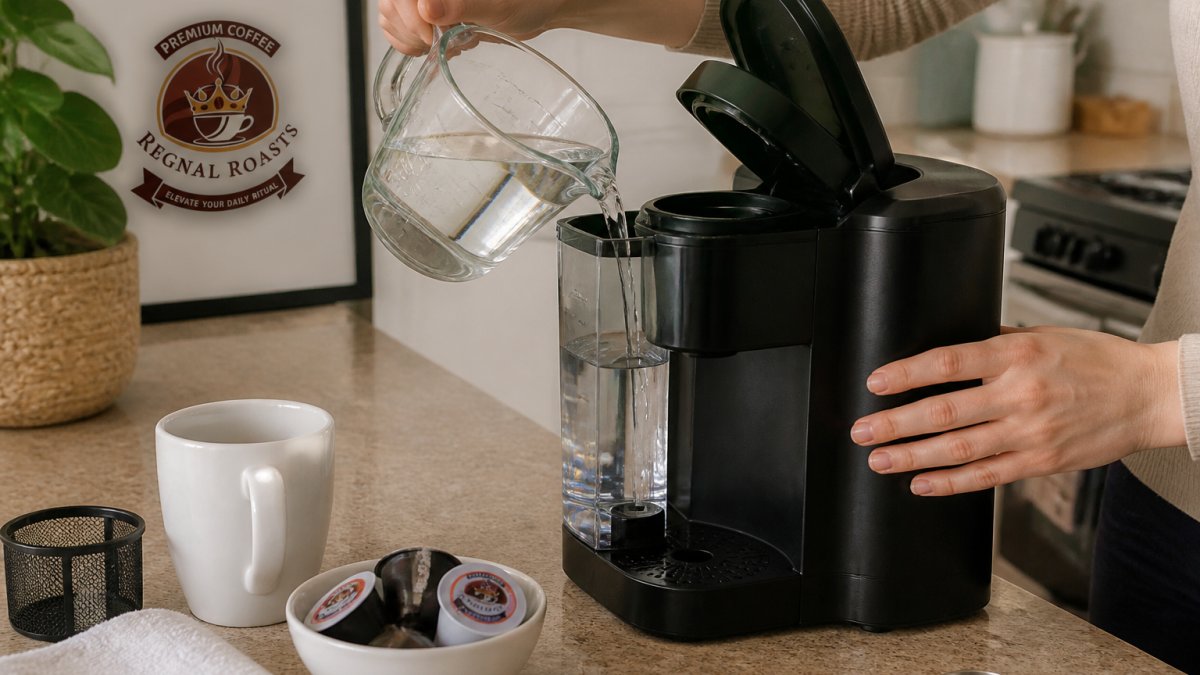
What you'll need: distilled white vinegar, fresh water, a measuring cup, and a mug.
Prepare the Reservoir and Run the First Cycle
- Empty any old water from the reservoir and rinse it once with fresh water.
- Mix equal parts white vinegar and water. For most single-serve reservoirs, that means 1 cup of each, or enough to fill the reservoir to its minimum brew line.
- Pour the mixture into the water reservoir.
- Place a mug under the brew spout.
- Run a brew cycle without a pod or coffee grounds, using the largest cup setting.
- Dump the mug. Do not drink it.
Expected result: The first cycle pushes vinegar through the brew line and loosens scale. The water may look cloudy or contain small flakes. That is normal.
Let the Solution Sit, Then Run the Remaining Cycles
- Let the vinegar solution sit in the reservoir for 20 to 30 minutes. This dwell time is what dissolves scale that a single pass misses.
- Run two more full brew cycles, dumping the mug each time. If the reservoir still holds solution after two cycles, run a third.
- Refill the reservoir with fresh water to the max line.
- Run two full rinse cycles, dumping the mug each time.
Expected result: By the second rinse, the water should run clear and the vinegar odor should fade. If either is not true, run one more rinse cycle.
Rinse to a Measurable Endpoint
Vague advice like "rinse until clean" is why so many machines keep a vinegar taste. Use this endpoint instead:
- Run at least two full reservoirs of fresh water through the machine after the descaler is gone.
- Smell the finished water in the mug. Any vinegar or sour note means one more full reservoir.
- Taste a small amount of the final rinse water only after it has cooled. It should taste neutral, with no sharp or sour edge.
How to Clean a Keurig Without Vinegar
You can clean a Keurig without vinegar by using citric acid or a commercial descaler instead.
Citric acid is the simplest swap. It comes as a powder, dissolves clear in water, and rinses out fast.
Some Keurig models also have a dedicated descale mode that walks you through the cycle step by step.
If you go the citric acid route, use the ratio in the table above and follow the same cycle-and-rinse process.
Citric Acid Coffee Maker Descaling: Ratios and Warnings
Citric acid coffee maker descaling uses a simple ratio: about 1 tablespoon of powder per 4 cups of water. Stir until the powder fully dissolves, then pour it into the reservoir.
A few warnings worth knowing:
- Never use citric acid powder straight. It is far too concentrated and can pit metal parts.
- Do not mix citric acid with vinegar. One descaler at a time is plenty.
- Rinse thoroughly afterward. Citric acid residue leaves a sour taste in the next few cups.
How Often to Descale a Single Serve Coffee Maker
How often to descale a single-serve coffee maker depends on your water and how much you brew. A common schedule is every three months for average use and hard water, and every six months for soft water and light use.
Use this quick guide:
- Daily brewer, hard water: every 4 to 6 weeks
- Daily brewer, soft water: every 3 months
- Occasional brewer: every 3 to 6 months
Hard water is the biggest factor. If you see white crust on your faucets, your machine is getting the same minerals. Many manufacturers publish a descaling schedule in their manual, and it is worth following it over any general rule.
How to Rinse a Coffee Maker After Descaling
Rinsing a coffee maker after descaling takes two full cycles of fresh water, and sometimes three. The goal is to flush every trace of the cleaning solution out of the brew line.
Follow these steps:
- Fill the reservoir to the max line with fresh water.
- Run a full brew cycle into a mug, then dump it.
- Repeat at least once more.
- Smell the finished water. If you catch any vinegar or sour note, run one more cycle.
- Wipe down the reservoir and brew area with a clean cloth.
Skipping the rinse is the most common mistake. Leftover descaler makes the next several cups taste sharp and sour, and it can leave residue in the brew line.
Troubleshooting and What Not to Use
Most descaling problems come down to a few fixable issues. Here is what to do when the process goes sideways.
The machine still brews slowly. The scale may be heavy.
The vinegar smell won't leave. Run two more fresh-water rinse cycles. Leaving the reservoir open to air for a few hours also helps.
Water won't flow at all. The brew needle may be clogged with scale or coffee grounds.
What not to use: never use bleach, dish soap, or abrasive cleaners inside the machine.
Once the machine is clean, the coffee finally tastes like it should. That is where a fresh, handcrafted pod earns its keep. Regnal Roasts offers K-Cup compatible pods in bold dark roasts and smooth single-origin blends, so a clean machine and a fresh pod work together. Discover the perfect roast to elevate your daily ritual and savor life's finer flavors with our premium, K-Cup compatible pods. Subscribe to our emails.
Frequently Asked Questions
Does vinegar actually descale a single serve coffee maker?
Yes, distilled white vinegar dissolves the calcium and magnesium deposits that form limescale inside the reservoir, brew line, and needle. The standard mix is equal parts white vinegar and water. Keurig, however, publishes model-specific descaling-mode instructions, and vinegar guidance generally comes from broader coffee-maker cleaning pages rather than every pod machine's manual. Check your machine's instructions before running vinegar through it, and always follow with several fresh-water rinse cycles so no vinegar odor or residue reaches your next cup.
Can you use citric acid to descale a pod coffee maker instead of vinegar?
Citric acid works as a natural descaler and leaves no vinegar odor, which makes it a popular choice for pod machines. Dissolve roughly one to two tablespoons of food-grade citric acid powder in a full reservoir of water, run the brew cycle without a pod, let it sit, then repeat and rinse thoroughly with fresh water. Follow your manufacturer's instructions for the descaling mode, and never mix citric acid with vinegar in the same cycle.
How often should you descale a single serve coffee maker?
Most manufacturers recommend descaling every three to six months, but hard water shortens that window considerably. If you notice slow brewing, a clogged needle, or a mineral film in the water tank, descale sooner. Homes with very hard water may need a cycle every four to eight weeks. Many pod machines also display a descale light that tells you when it is time, and running a cycle before the light appears is a safe habit for protecting flavor.
How many rinse cycles should you run after descaling a coffee maker?
Plan on at least two full reservoirs of fresh water, and three if you still detect a vinegar odor. Fill the reservoir with clean water, run a brew cycle without a pod, and repeat until the water runs clear and smells neutral. Empty and rinse the removable parts, including the drip tray and pod holder, by hand. Skipping the rinse leaves residue that can sour your next cup of coffee.
A clean machine is only half of a great cup. The other half is the coffee itself, and stale pods will undo every bit of your descaling work. Regnal Roasts roasts in small batches and packs K-Cup compatible pods with blends built for depth and distinction, from bold dark roasts to soothing single-origin sips. Pair your freshly descaled brewer with a pod that deserves it. Subscribe to our emails and find the roast that elevates your morning ritual.