

Bold Coffee Without Bitterness: Brew Guide
Table of Contents
- Why Bold Coffee Turns Bitter (and How to Stop It)
- The Best Grind Size for Bold Coffee
- Water to Coffee Ratio for Strong Brew
- Impact of Water Temperature on Coffee Flavor
- Troubleshooting Bitter Brews: AeroPress, Pour-Over, and Drip
- Cold Brew: A Low-Bitterness Path to Bold Flavor
- Conclusion
- Frequently Asked Questions
Last Updated: October 1, 2026
Why Bold Coffee Turns Bitter (and How to Stop It)
Bitterness in coffee is not a flavor you accidentally added, it is a set of chemical compounds you either extracted or did not. Understanding which ones, and when they come out, is the difference between guessing at your grind and knowing why your last cup bit back.
Green coffee beans contain chlorogenic acids (CGAs). During roasting, heat converts some CGAs into chlorogenic acid lactones (CALs), the primary bitter compounds in roasted coffee, not caffeine, which contributes only a small fraction of perceived bitterness. The longer and darker the roast, the more CGAs convert to CALs, so a dark French roast carries more bitter potential than a light city roast.
But bitter potential is not bitter taste, extraction unlocks it. Coffee solubles dissolve in sequence:
- First (early extraction): fruit acids, sugars, and aromatic compounds, the bright, sweet, complex notes.
- Middle: caramelized sugars and Maillard reaction products, body, chocolate, and nutty depth.
- Last (late extraction): tannins and the remaining chlorogenic acid lactones, the dry, harsh, lingering bitterness.
Over-extraction means pulling past the sweet middle into the harsh tail; under-extraction stops before the sugars arrive, leaving a sour, thin, salty cup.
Your brew has a target: the Specialty Coffee Association describes an ideal extraction yield of roughly 18% to 22% of the coffee's soluble mass, with a total dissolved solids (TDS) concentration typically between 1.15% and 1.35% for drip-strength coffee. Hit that window and bitterness stays in the background, adding structure rather than dominance.
Four variables move you in and out of that window:
- Grind size, surface area. Finer means faster extraction.
- Water temperature, reaction speed. Hotter means faster extraction.
- Brew time, contact duration. Longer means more extraction.
- Ratio, coffee-to-water mass. More coffee per unit water means higher concentration, not necessarily higher extraction.
Ratio is the odd one out.
To stop guessing, measure extraction directly. A refractometer reads the TDS of your brewed coffee in seconds, and paired with your brew weight you can calculate extraction yield. Most home brewers who adopt one find their "bitter" cups were over-extracted by several percentage points, and a single grind adjustment fixes it.
The Best Grind Size for Bold Coffee
The best grind size for bold coffee is medium-coarse, similar to sea salt. Too fine and water over-extracts, releasing bitterness. Too coarse and you get a weak, sour cup.
For bold flavor without bite:
- Pour-over: medium, like table salt
- Drip: medium, slightly coarser than pour-over
- French press: coarse, like raw sugar
- AeroPress: medium-fine to medium
- Cold brew: extra coarse, like peppercorns
Burr Grinder vs. Blade Grinder
A burr grinder crushes beans between two rotating surfaces, producing even particles. A blade grinder chops them, leaving a mix of dust and boulders.

Water to Coffee Ratio for Strong Brew
The water to coffee ratio for strong brew starts at 1:15 by weight, meaning 1 gram of coffee to 15 grams of water. For a bolder cup, tighten to 1:14 or 1:13. Going stronger than 1:12 usually just adds bitterness.
| Brew Method | Coffee (grams) | Water (grams) | Ratio |
|---|---|---|---|
| Drip | 20 | 300 | 1:15 |
| Pour-over | 22 | 350 | 1:16 |
| French press | 30 | 400 | 1:13 |
| AeroPress | 17 | 220 | 1:13 |
| Cold brew | 100 | 500 | 1:5 |
Using a Scale for Consistency
A kitchen scale costs little and removes guesswork. Weigh your beans, then your water: same numbers every morning, same cup every morning.
Impact of Water Temperature on Coffee Flavor
Water temperature affects coffee flavor more than most people expect. The sweet spot is 195°F to 205°F: above that you scorch the grounds and pull out bitterness, below it you under-extract and get a sour, thin cup.
The Bloom: Why It Matters
The bloom is the first pour of hot water onto fresh grounds. Coffee releases trapped carbon dioxide, and the bed puffs up and bubbles.
Troubleshooting Bitter Brews: AeroPress, Pour-Over, and Drip
Match the fix to your brewer, and change one variable at a time, change grind, temperature, and time together and you learn nothing about which one helped. The workflow below assumes you start from a bitter cup and want to isolate the cause.
Measure First, Adjust Second
Extraction yield (%) = (TDS % × brewed coffee weight) ÷ dry coffee weight
Degassing and Bean Freshness
Freshly roasted beans release carbon dioxide for several days, and that CO2 repels water at the surface of the grounds, causing uneven extraction. Some pockets over-extract while others under-extract, so the cup tastes both bitter and sour at once.
AeroPress
AeroPress bitterness usually traces to steep time past 2 minutes, too fine a grind for the steep length, or water above 200°F. Start with a 1:13 ratio (17 g coffee to 220 g water), a medium-fine grind, and a 90-second steep at 195°F. If still bitter, coarsen the grind one notch before shortening the steep, grind is the more sensitive variable.
Pour-Over
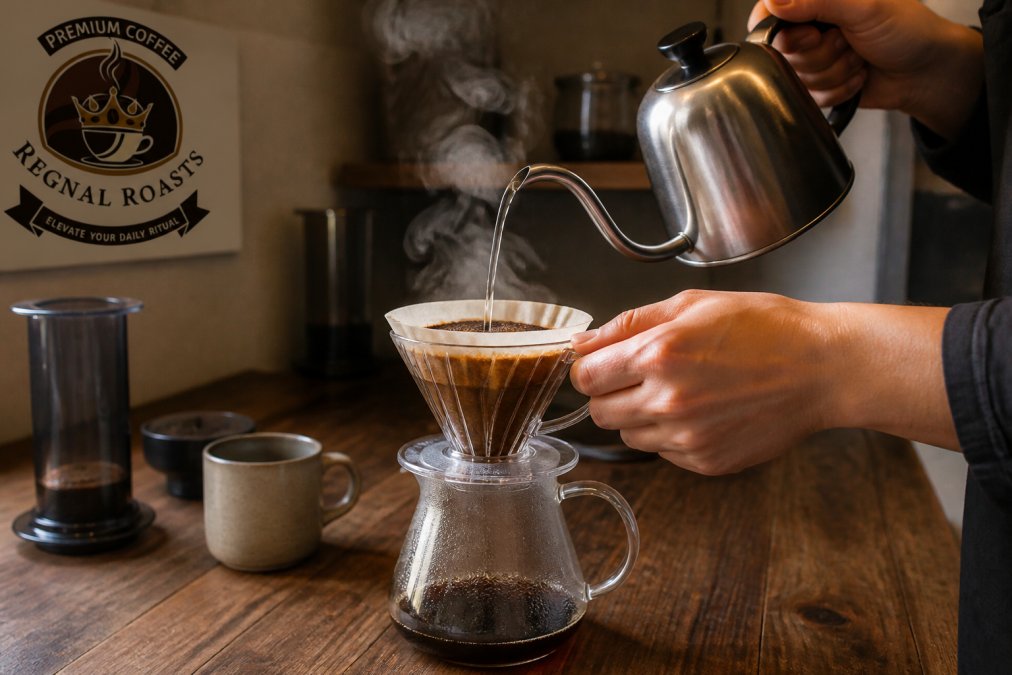
A bitter pour-over is often a pour problem, not a recipe problem. An uneven bed lets water channel through shallow spots and over-extract them while deep spots under-extract. Keep the water level steady, pour in slow concentric circles, and finish in 3 to 4 minutes. If the brew finishes faster than 2:30 and tastes bitter, your grind is too coarse and the water is racing through, counterintuitively, go finer to slow it down and extract more evenly.
Drip
Most drip machines start at 200°F-205°F but drop below 195°F as the reservoir empties, and many cheap models cycle on and off, swinging 10 to 15 degrees, a bitterness factory. If your machine has no temperature control, coarsen the grind and use a 1:16 ratio to offset the hotter early phase. Clean monthly with descaling solution and a plain-water brew; old coffee oils go rancid and add a harsh, stale edge that mimics bitterness.
Water Chemistry
If your extraction yield is in range and your beans are fresh, look at your water. Very hard water (high magnesium and calcium) extracts aggressively and can push a balanced recipe into bitterness, while very soft or distilled water under-extracts and tastes flat. A carbon or pitcher filter removes chlorine and some hardness. For precision, a cheap TDS meter tells you whether you start from 50 ppm or 300 ppm, a difference that matters more than most brewers realize.
| Problem | Likely Cause | Fix |
|---|---|---|
| Sharp, bitter taste, yield over 22% | Grind too fine | Coarsen one notch, re-measure |
| Bitter and weak, yield in range | Water too hot or too hard | Lower temp to 195°F, filter water |
| Bitter and sour at once | Uneven extraction from fresh beans | Rest beans 3-7 days, extend bloom |
| Sour and thin, yield under 18% | Grind too coarse | Finer grind, re-measure |
| Inconsistent cups day to day | No scale, no measurement | Weigh coffee and water, track TDS |
Cold Brew: A Low-Bitterness Path to Bold Flavor
Cold brew skips heat entirely, so it never pulls the harsh compounds hot water does. The result is a bold, smooth concentrate with low acidity and almost no bitterness.
Try Regnal Roasts Cold Brew Blend
Our Cold Brew Coffee - Dark Roast is built for this exact method. It's a dark French roast, ground extra coarse, so it extracts slowly and cleanly. The flavor is bold and smooth with a rich, clean finish and no bitterness.

Conclusion
Bitter coffee is fixable, and the fix rarely costs much. Coarsen your grind, weigh your ratio, drop your water temperature, and watch your brew time. Do those four things and bold flavor shows up without the bite.
Frequently Asked Questions
How to brew coffee that doesn't taste bitter?
To avoid bitterness, use a coarse grind, keep water between 195°F and 205°F, and aim for a 1:15 coffee-to-water ratio. Over-extraction causes bitterness, so shorten brew time if needed. For dark roasts, lower the temperature slightly. Cold brew is a reliable low-bitterness method; Regnal Roasts offers a Cold Brew Coffee - Dark Roast ground extra coarse for slow, clean extraction.
What cancels out bitterness in coffee?
A pinch of salt can neutralize bitterness by blocking bitter receptors on your tongue. Adding a small amount of milk or cream also masks it. But the best fix is proper brewing: adjust grind size, water temperature, and ratio. For bold coffee without bitterness, start with fresh, high-quality beans like Regnal Roasts' Sumatra Single Origin, which has a syrupy body.
Does grind size affect coffee bitterness?
Yes. A fine grind increases surface area, leading to faster extraction and more bitterness. A coarse grind slows extraction, reducing bitterness but potentially causing sourness if under-extracted. For bold coffee, use a medium-coarse grind for drip or pour-over, and coarse for French press or cold brew. The best grind size for bold coffee depends on your method, but coarser is safer against bitterness.
What is the ideal water temperature for brewing bold coffee?
The ideal water temperature is between 195°F and 205°F. Water that's too hot (above 205°F) scalds the grounds, extracting harsh, bitter compounds. Too cool (below 195°F) leads to sour, under-extracted coffee. For dark roasts, aim for the lower end (195°F-200°F). Use a thermometer or a temperature-controlled kettle. This range balances the impact of water temperature on coffee flavor, giving you boldness without bitterness.